Monday, May 5, 2014

Chon-Kemin, Kyrgyzstan, 5th May

From Cholpan Ata we drove to  Karakol stopping on the way to visit the Przewalski Memorial and museum. Nicolai was the Tsarist Russian Army Officer who made 4 long exploration journeys in Central Asia and into Siberia, Tibet and Western China between 1860 and 1888. Apart from the famous horse he found lots of new flora and fauna.

Karakol has a lot of gingerbread wooden Russian houses shaded by huge white poplars. We stayed at the Green Yard hotel, a nice homely place which had reasonable Wifi and a corner shop which sold beer. Kyrgzystan is a great place for jam. We had 6 varieties at breakfast and the locals even put it in their tea.


May 3rd we went to the Dejety Oguz gorge or Seven Bulls Gorge - red sandstone cliffs. Driving further up the Karakol Valley we came to alpine meadows, but we are just a week or two early for the spring flowers. However it was a lovely place with lots of horses and some flocks of sheep and goats.

May 4th we started by visiting the animal market in Karakol. No donkey carts these days. The animals come in cars, trucks and even the occasional taxi and the traditional white felt hats of the men are now largely replaced by baseball caps. A little later we passed a much smaller market about 30 km down the road where there was plenty of animal-drawn transport. The first section in Karakol is sheep and goats. Another section is for cattle and horses with far more of the latter. Some prices: twin black lambs, 3,500 som or ~$70. a fat sheep about $200, a cow $800-$1400 and horses from $1400 to $2400 so they are not cheap. All sales are by private negotiation but it looked as if a lot of animals were not sold.

Our next stop was for a demonstration of eagle hunting, but the rabbit was lucky and got away three times.

We drove along the shore of Lake Issy Kul to Kochkor where we stayed with a local family. We had a huge room where the walls were covered with embroideries and patchwork and there was a large pile of quilts in the corner. In Kochkor we visited a felt making cooperative involving 200 local women. One of the very common patterns is Heracles (of Greek mythology). Alexander's shadow is very long. The Russian word for walnuts is Greek nuts The nuts are  native to Central Asia and it was Alexander or his generals who cultivated them in Greece.


May 5th was a short drive to Chon-Kemin through mountain scenery. Lunch was a picnic by a stream (there was a picnic table!) and we are staying in a guesthouse which has Wifi. but I will let the pictures speak for themselves.
 Typical Krygyz felt floor rug. About 6ft x 8 ft would take 1 woman about 8 months to make.
 19thC Russian Gingerbread house in Karakol.

Pastoral scene in the Karakol Valley. There are horses everywhere and the shepherds are all mounted.

 Although spring is almost here there are hardly any flowers yet. My eyes thought these flowers were pink but my camera thought differently.
 
 I am glad I was not driving over these bridges in the Karakol Valley, but our driver had plenty of icons (Russian? on the dash of his car) so we were O.K.
 
Djety Oguz Canyon or Seven Bulls. 
 
Fat tail sheep in Karakol market

 The black lamb just visible in the centre would set you back 3500 som or about $70.
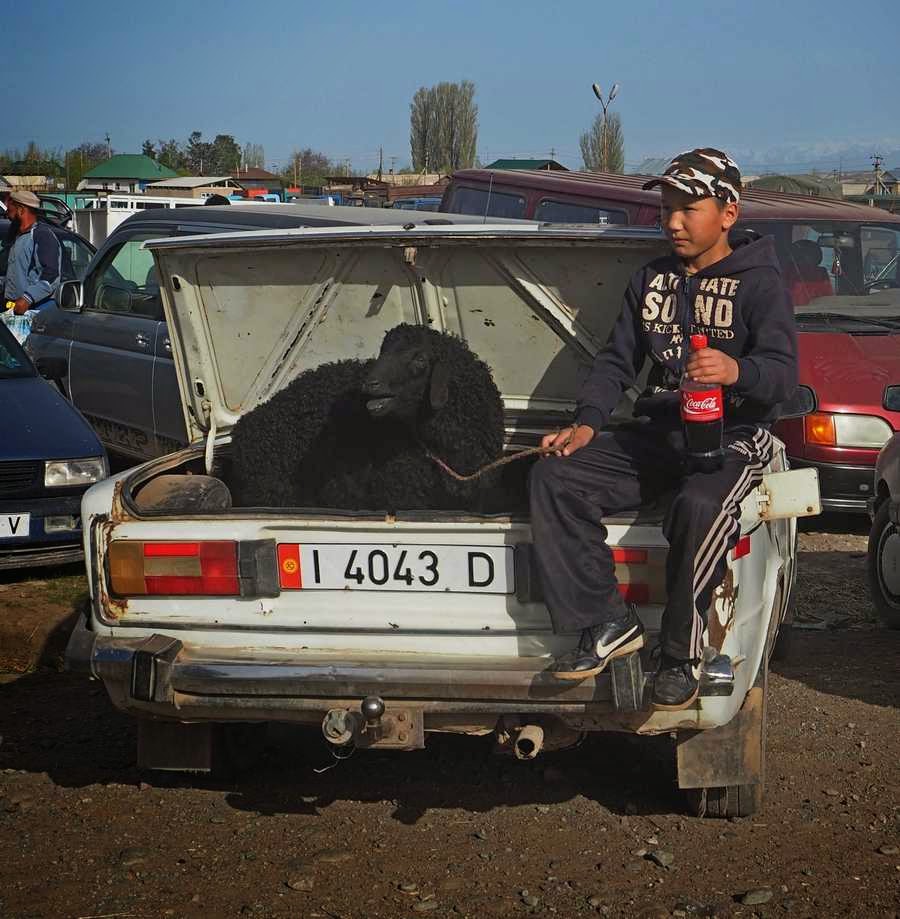
Waiting for an offer!
Mare and foal on offer.l
Or does this one appeal more?
Talgarbek, an eagle hunter with Tumara his eagle. She is 10 years old and he took her from the nest before she had flown.and trained her.
A new profession for Bill.
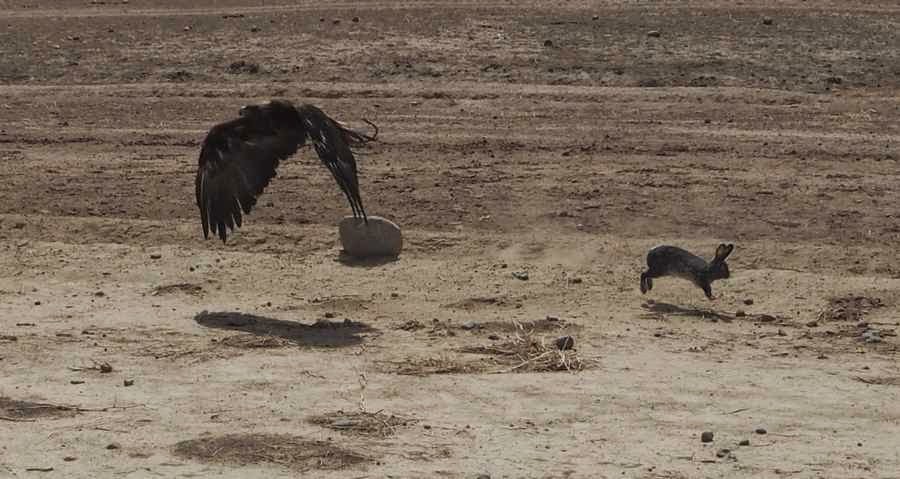
Tumara makes a dive, but the rabbit escapes.
Talgarbek with the rabbit in one hand and Tumara on the other arm.
Simple Russian Orthodox church in Karakol.
Feltmaking in Kochkor The wool is teased and then spread out on a reed mat. A pattern of different coloured wools is added and the whole is then rolled up and wet with hot water and then pressed. It was Sunday and both restaurants in town were closed so the woman in the picture quickly rustled up a nice lunch for us.

Patchwork and felting in Kochkor.
Part of the large wall hanging in our room in Kochkor. It was made of velvet.

Saturday, May 3, 2014

Karakol, Kyrgyzstan, May 3rd.

April 30th. We arrived in Bishkek at 4 in the morning and were immediately aware we were in a different country. Within 20 minutes we had collected our luggage, had our passports stamped and walked through the Green "nothing to declare" customs lane and were off to our hotel.

Bishkek is about 1 million people and has just turned green for spring. We noticed a lot of cars are right hand drive Japanese 2nd hand imports although traffic drives on the right. We first visited the Frunze House museum, a 19thC thatched cottage and then walked through Oak Park, a lovely park with lots of sculptures left after a big Soviet sculpture  exhibition in about 1980. The State History and Art Museum had a lot of interesting exhibits and stunning views of the mountains from the windows. The carpets here are mostly felted. All the textiles have markedly different patterns from Uzbekistan.

We finished the day in the Osh Bazaar which is pretty lively and we were able to stock up on dates and nuts.

May 1st. Today we left Bishkek and drove first to the BuranaTower a 10thC brick structure on the site of  the more ancient Sogdian city of Balasagun. Nearby is a collection of balbals or Turkic totem-like stone markers.
We drove onto Cholpon-Ata where we stayed in a resort hotel - not quite our cup of tea. Apparently rich Russians and Kazakhs come here for Lakeside holidays. Lake Issy Kul is a huge alpine lake at a height of 1800m. We were more interested in the petroglyphs some dating back to 1500 B.C. but mostly from the Zoroastrian period 6thC B.C. to 1stC A.D. There is a large field of glacial boulders and we wandered around and found a few and also some stone circles.


Sculpture in Oak Park, Bishkek
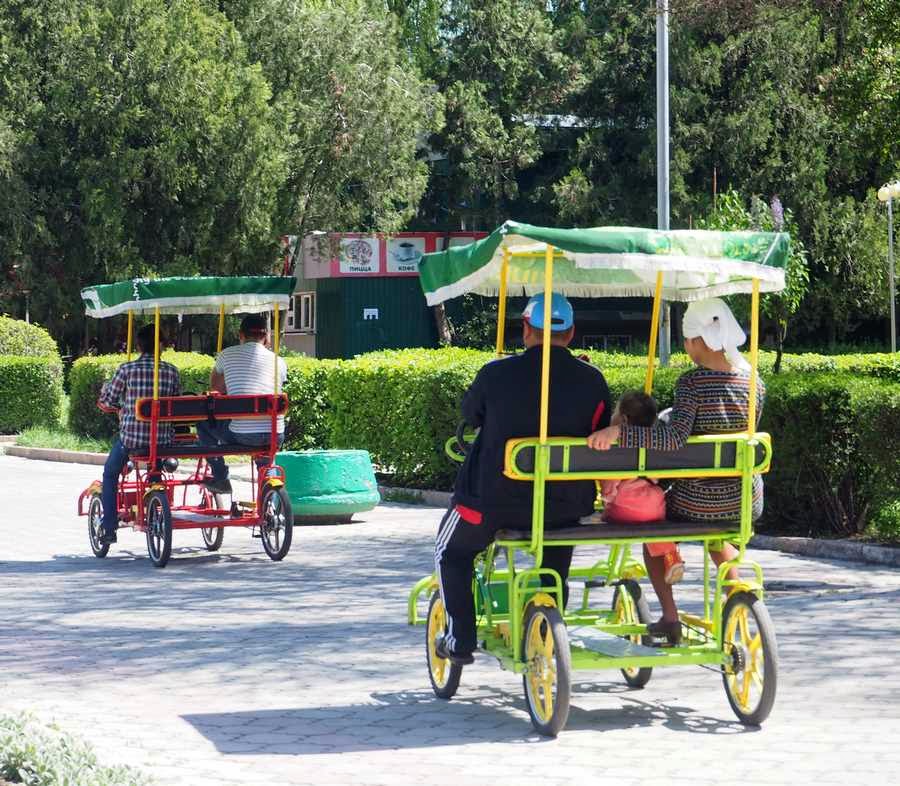
Spring has arrived in Bishkek and locals were enjoying the sunshine.
A Zoroastrian ossuary in the State museum.
Kyrgyzstan wall hanging
Patchwork!
Fetishes all featuring vicious claws.
 Mr Minute in Osh Bazaar, Bishkek
Plenty of competition between bakers.
 Like a dried yogurt ball?
A broom seller in a Kyrgyz felt hat

10thC brick Burana Tower
Petroglyphs at Cholpan Ata.
Much simpler mosques here and sometimes I need to check whether it has a crescent or a cross as the architecture is similar to local orthodox churches.
 More up market mosque.
 This mosque in Karakol belongs to the Dungan community - a Chinese Moslem people who fled China in the 19thC.
Holy Trinity cathedral, Karakol.
Not a country for vegetarians!
Balbal (Turkic totem like stone markers) from 6th - 10thC.
Leather container used by nomadic people.
Stunning mountains.

Thursday, May 1, 2014

Fergana Valley, Uzbekistan, April 30th

27th April:   We left Samarkand to return to Tashkent - a 4 h drive across fairly flat country which would be almost desert but is irrigated for cotton and wheat. We stopped to buy strawberries on the roadside but it was not a noteworthy drive.

The following morning we left for the Fergana Valley. It has always been known as one of the most fertile regions in Central Asia and today 8 million or one quarter of Uzbekistan's population lives here. 


In the 19thC it was under the Khan of Kokand, the largest of the 3 khanates who ruled present day Uzbekistan and beyond (the other two khanates were Khiva and Bokhara).  It is the most conservative and Islamic part of Uzbekistan and is also known for its handcrafts particularly Rishton pottery and ikat silk weaving at Margilon.

It was a long drive to Fergana and in parts a very slow road over the Kanchik  Pass at 2267m  with major roadworks and where there were still drifts of snow. Unfortunately because of the industrialization the air was not clear, even though many factories are now derelict.

On the way there lots of people planting spring flowers along the roads and in towns at the roundabouts.

On 29th April we returned to Tashkent  but it was a very long day. We started at 8.30 and visited various sites around the Fergana Valley until about 3 pm when we finally set off for Tashkent arriving there after 9 pm.
It hardly seemed worth checking in as we had to leave the hotel at 11 to catch the 2 a.m. flight to Bishkek, but we persuaded the hotel to provide us with a breakfast box at 10.40 p.m. which we ate in the lobby.
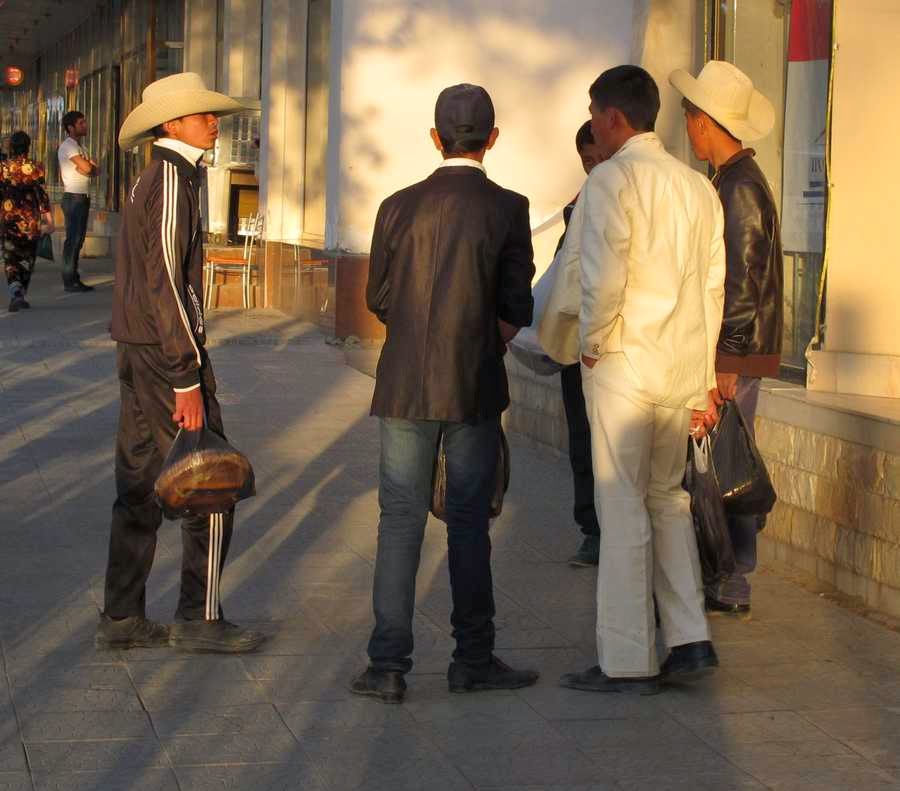
 A final Samarkand picture - the Wild West..
 
 Dinner in a posh yurt in Tashkent and very nice it was.
 
A group of Uzbeki men enjoying lunch in a roadside cafe along the Fergana Valley road.
 
 This aivan (portico) in the Jumi mosque in Kokand is supported with 98 red wood columns  brought from India at the end of the18thC.
 
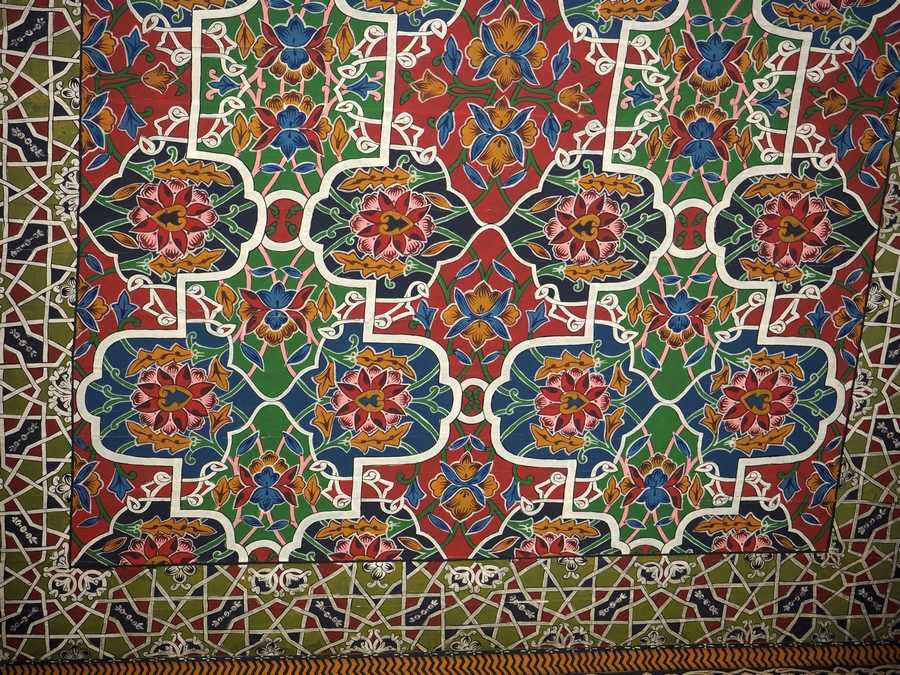
 Gorgeously painted wooden ceiling in the Aiwan.
 

 Bibi our guide watching a potter at work in Rishton. The local clay is of an exceptionally high quality and requires no additives. The traditional green and blue Islamic designs are very attractive.

 Hand painting tiles in Rishton.

We visited the Yodgorlik Silk Factory in Margilon. This girl is plying the silk from about 30 cocoons.
 
 The vats for boiling the dyes (mostly natural)
 
 Laying out the warp threads ready for weaving. A modern innovation is to use sellotape instead of cotton thread to tie the bundles of thread together.
 
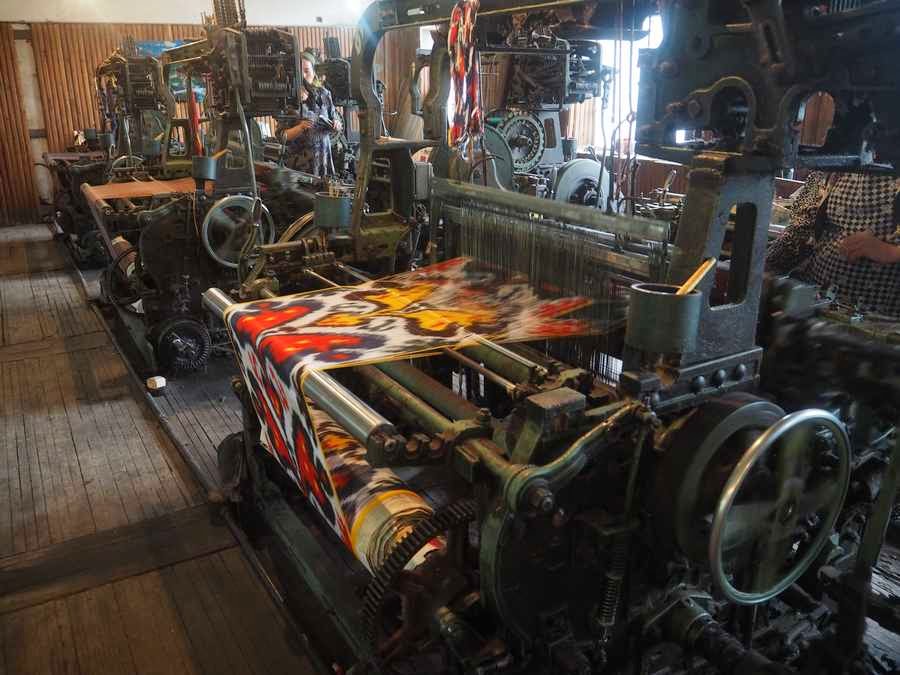
Machine weaving Ikat. This is much faster than hand weaving, but also much noisier!
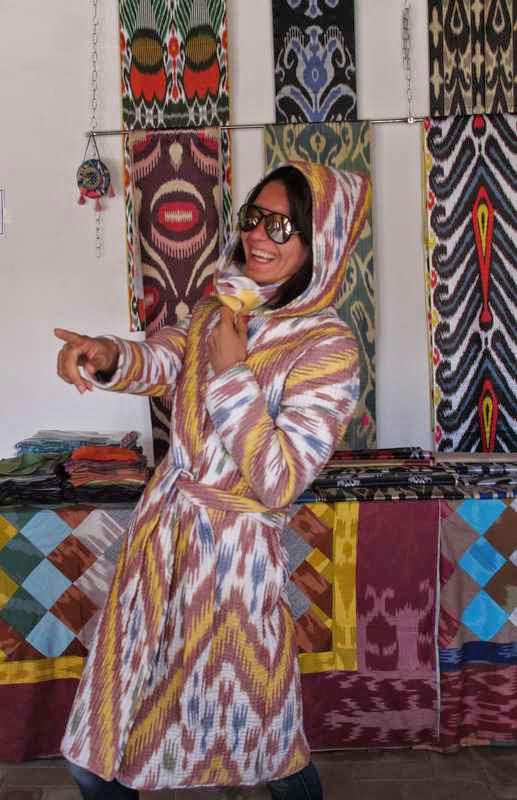
Bibi models a padded cotton Ikat coat.
The Jumi mosque in Andijon survived the 1902 earthquake. Its design and its minarets are more Indian or Persian  than Central Asian.
More conservative women's dress in the Fergana valley towns.
Vegetable/Herb sellers in Andijon market.