Tuesday, June 9, 2015

Guru Humorulei, Moldavia, June 8th

On Thursday we left Sibiu and drove first to the Turda Salt mines where mining originally started in the 14thC. It was a long walk in and then a lift down. As you can imagine the cavern is huge.There is a ten pin bowling alley and a lake with little boats for hire.Altogether rather weird. It is not far from Cluj Napoka, a town of 230,000 people of whom 80,000 are students.  The Botanical Gardens are excellent even if we missed the 140 varieties of tulips. The city was a centre of Hungarian culture and there are fine 18thC buildings such as the Opera House. Later in the day we made our way to Surdesti church, built in 1720 and for a long time the tallest wooden building in Europe. We were within 100 m. of the Ukraine border.
 In the saltmine at Turda
 The beautifully carved pulpit in the catholic St Michael's church in Cluj Napoka.
Built in 1724, the church at Surdesti has a 72m tower. 
 
 Frescoes from Surdesti.
 
Making cheese in Maramures
 Typical elaborately carved wooden gate in Maramures region. The rope  symbolises the twists and turns of life.
 
 Haymaking season
Returning home after a day in the field,. note the wooden pitchfork.
Not sure what is in the basket.
General view of the countryside.
The village still in Iza. Plum and other fruit brandies are made.
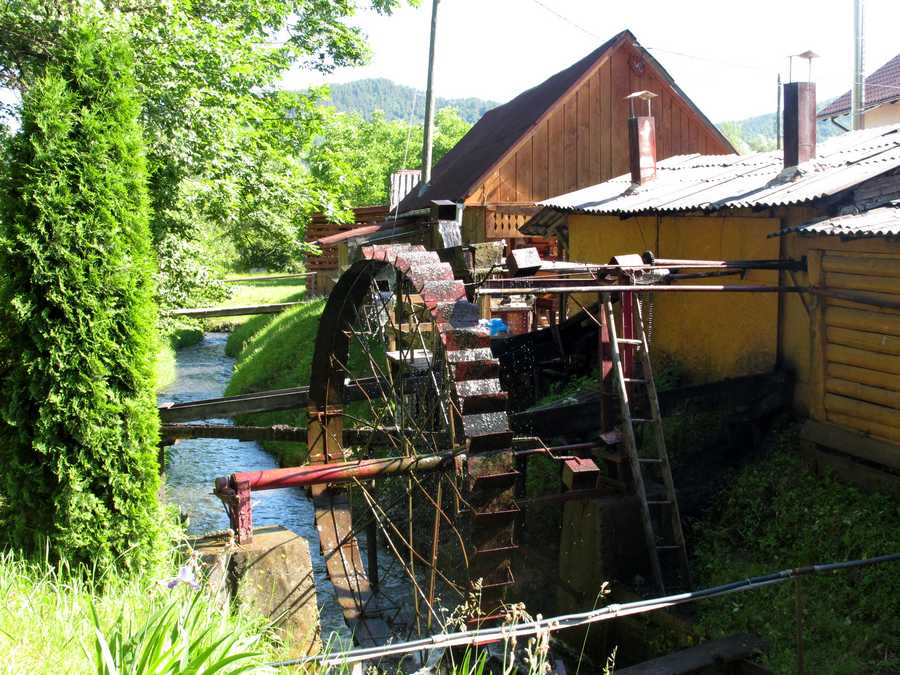
Water power is used for various community activities in the village including a whirlpool washing machine for washing carpets.
George and I relax on the swings near the still, but we did not try the brandy.
Village weaving and embroidery.
Another local industry is painting icons on glass. St George and the dragon in this case.
Flower sellers in Sighet market.
The lovely cheese lady in Sighet market.
A few examples of the painted tombstones in Sapinta 'Merry Cemetery'.
I think this is Sapinta Peri, the tallest wooden structure in the world
In the village of Iza we stayed in an excellent homestay (they made excellent pickles and of course plum brandy). An added bonus was a Maramure folklore show.
The man on the left is our host.
Sunday morning and everybody is walking to church - dressed in their Sunday best.
The service at Barsan monastery was in full swing. It goes for about 4 hours and there is a lot of beautiful chanting by both monks and nuns.
The museum lady in Dragomiresti. The museum is in a 235 year old house. She is standing next to a dowry tree.
Some of a large flock of sheep being driven through town.
General view of one of the famous Bucovina painted monasteries.
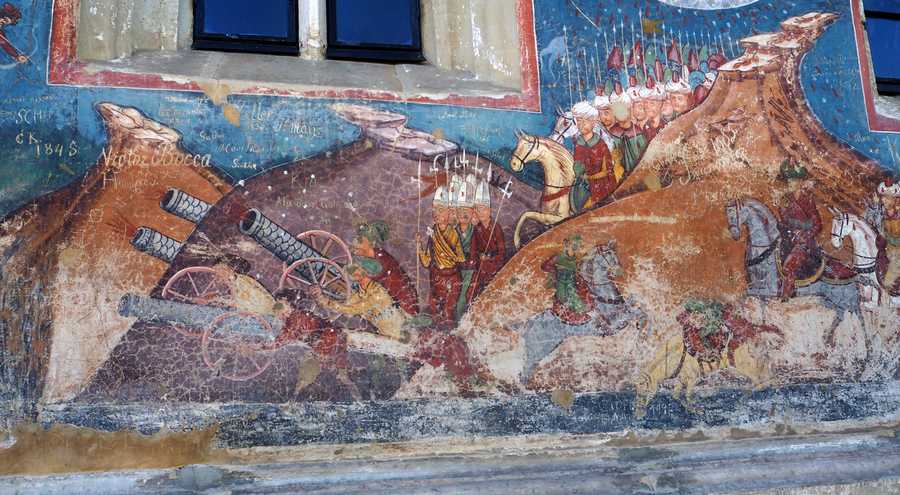
The siege of Constantinople.
The red tassels are to get the horse used to traffic on the road.

Thursday, June 4, 2015

Sibiu,Transylvania, June 3rd

It was Sunday when we arrived in Bucharest. We avoided the taxi touts and found our driver who gave us a bit of a scenic tour on the way to the hotel. We ventured out from the hotel and found a bar. The beer is good and cheap and the cafe food is also cheap and good. I didn't realise polenta would be so popular.

Monday and George picked us up and showed us Revolutionary Square and the balcony from where  Nicolae Ceauescu?, tried to make his final speech.

Our next stop was the Palace of Parliament. It is hard to comprehend the sheer enormity of the building. As the ceilings are 12 to 19m high, it is a long climb to the third floor via a grand marble staircase. At least Ceauescu was a patriot and it is all built of Romanian materials. I was worried about the wear on the huge carpets (all specially woven to fit the huge halls. It takes twenty men to unroll some of them)  from the tourists tramping over them..

Our next stop was the village open air museum with examples of the architecture from around the country. June 1st was Orthodox Pentecost and also Children's Day so the site was buzzing.

We visited the apartment of a famous author still looking as it did in 1931 and then in the evening had a Folklore dinner and show in a cellar restaurant


 The Palace of Parliament. It is impossible to give an idea of the size (around 20,000 sq m).
One of the cottages in the Village museum. It is beautifully laid out with well cared for gardens.
 Interior of the cottage
 
 Romanian patchwork
It was Orthodox Pentecost and Children's day so there were children everywhere.
 
 Interior of an Upper Middle Class apartment unchanged since 1931
Cellar restaurant in Bucharest.
 
 Entertainment in the restaurant.
 
Brancovan architecture at Mogosoaia Palace.It is on a lake with beautiful gardens and is popular for weddings.
 
All waiting at the petrol station. Service stations have very clean toilets and a good range of snacks and light meals.
 
 Roadside barbeque - highly recommended.
 
 My old favourite St George at the 14thC Cozia Monastery
 
 The grand foyer of our hotel in Sibiu. The dining room was all gilt chandeliers and mirrors.
 
 Sibiu is a Saxon town founded by Germans in the 12thC. The sleepy eye dormer windows are a feature of the buildings around the square.
The organ in the Lutheran church in Sibiu
 
 One of the ostentatious houses of the gypsy barons in Hunedoara
 
Local beauties
The brass band was playing in the square in Sibiu.

Monday, June 1, 2015

Night train to Bucarest, May 31st

We flew to Budapest from Baku - via Istanbul, a busy chaotic airport.

Our three days in Budapest were worth the trip. Visually the city is attractive with treelined streets lined with 19thC buildings - mostly 4 or 5 storeys high (the top floors are much less grand.


Just north of the city are the ruins of the Roman garrison of Aquincum on the Eastern border of the  empire and occupied for about 400 years. Marcus Aurelius, Hadrian and Septimus Severus were all here. The area of the ampitheatre is bigger than the Colisseum although there were never so many seats. There are the ruins of enormous public baths. The Soviets built a highway over the top of the ruins. It would have allowed easy access to Vienna during the cold war.  Even on the edge of the Roman Empire they Romans knew how to live the good life. 
  As to be expected, there are lots of Soviet era apartment blocks and some are being refurbished and becoming fashionable.

Refurbished Soviet era apartments
 
  Szentendre a very pretty village with high class souvenirs.
Visigrad has a large medieval citadel  and at Solomon's tower the local enthusiastic Knights of St  George were holding a mock medieval tournament which was great fun.

The bowmen were pretty accurate.

 Views over Budapest from Gellert Hill

The Lberty monument.
On Gellert Hill there is an huge bronze statue holding a feather of the legendary Turul bird. It was originally erected in 1946? to celebrate the victory over the Nazis by the Russian army, but the Russians stayed until 1989 and then the Cyrillic text was removed and the statue renamed Liberty.
 The Parliament building near the Danube in Gothic style is marginally and deliberately slightly bigger than Westminister.
Floodlit at night it is spectacular.
The recently restored church of St Matthew on Castle Hill.
Another view of the spectacular tiled roof.
Gustav Eiffel designed the Market hall

 Paprika everywhere but I bought cherries.

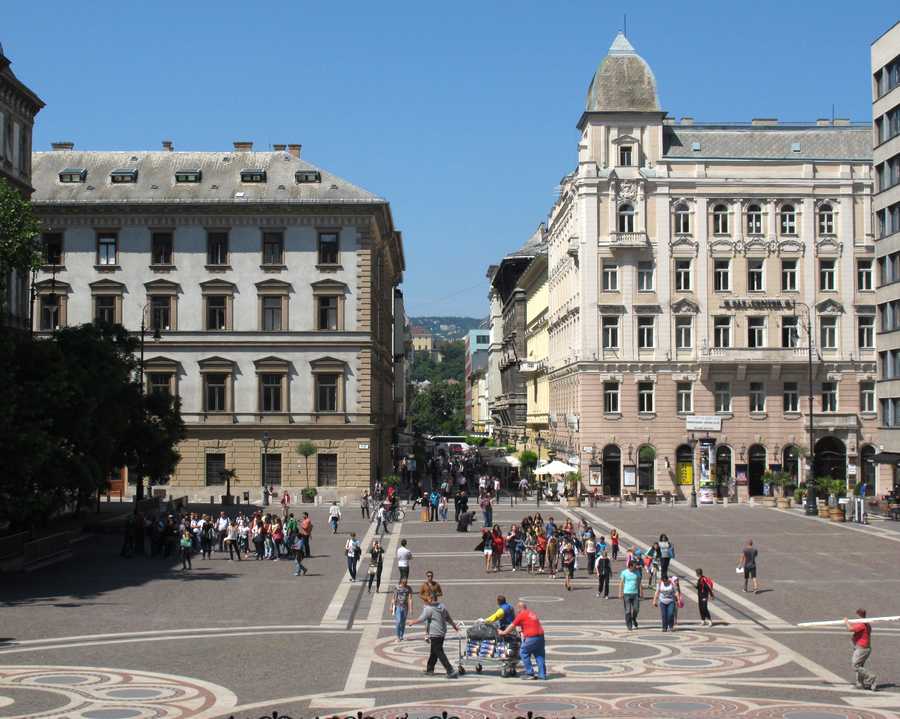
Some general street views showing the grand buildings. Tram No 2 which runs along the Danube is a good way to see the architecture.
Finally after walking and tramming around the city we dropped into a bar and found these characters playing cards,
We caught the night train to Bucarest, much easier to get aboard than flying, but the first class sleeper was not grand, however I slept well until the two lots of passport control in the middle of the night.