Wednesday, November 16, 2011

Pedro de Atacama, Chile

San Pedro de Atacama. Tuesday Nov 15th.

We had a tail wind across the Pacific and landed in Santiago an hour after we left Sydney. Sunday afternoon we walked to the Museum of Pre-Columbian Art. As it was Sunday most shops were closed but plenty of people were out strolling. There are many fine 19thC buildings but far too much graffiti.

The museum has a great collection mostly ceramics but including heaps of very ancient intricately woven textiles.


Three Graces fountain in Santiago.
Some of the mainly Mayan ceramics in the Pre Columbian museum in Santiago.

Monday morning we flew to Calama. Flying along the snow covered peaks of the Andes, which we had not been able to see in Santiago because of the haze/smog. It was then an hour's drive across the desert to San Pedro de Atacama, an oasis town. This hotel is lovely - enormous hollihocks in the gardens and at the bar, everything except Chivas Regal (18 yrs old) and Red Bull is included in the room rate!

Looking out the plane window - between Santiago and Calama.
Hollihocks in the garden of the Tierraatacama hotel.
Our room has a terrace and a view of a volcano (dormant) with an almost perfect cone and some snow, although strangely the snow only fell recently as a result of some very unusual weather conditions.

View from our window at the Tierraatacama.
Last evening we went to the Salt Lakes to see the flamingoes and to watch the sunset. On the way we drove past the site of the new very large radio telescope - an international project with 750 people building it in the middle of nowhere at an altitude of 5000 metres.

We walked around the small village of Toconao and visited the little church. Apparently the Spaniards used to send the faces and hands for the statues of the saints, from Spain and the locals completed the figures. In San Pedro ithere was a statue with articulated arms and legs and the locals could have their photo taken with San Pedro's  arm around them or on his lap, etc. I like the idea of such friendly and homely saints, but apparently someone (an evangelic is suspected) did not and recently burnt the statue.
Small reservoir of fresh water at Toconao which is used to irrigate orchards of apricots, quinces etc.
Cactus wood door in the church in Toconao. This is a very hard dense wood, but  only if you harvest wood from dead cacti.
The Trinity, i.e. Father, Son and Holy Ghost.


Flamingoes take off fromthe Salt lake.
A lone flamingo as the hills behind start to colour as the sun sets.
Sunrise from our room.
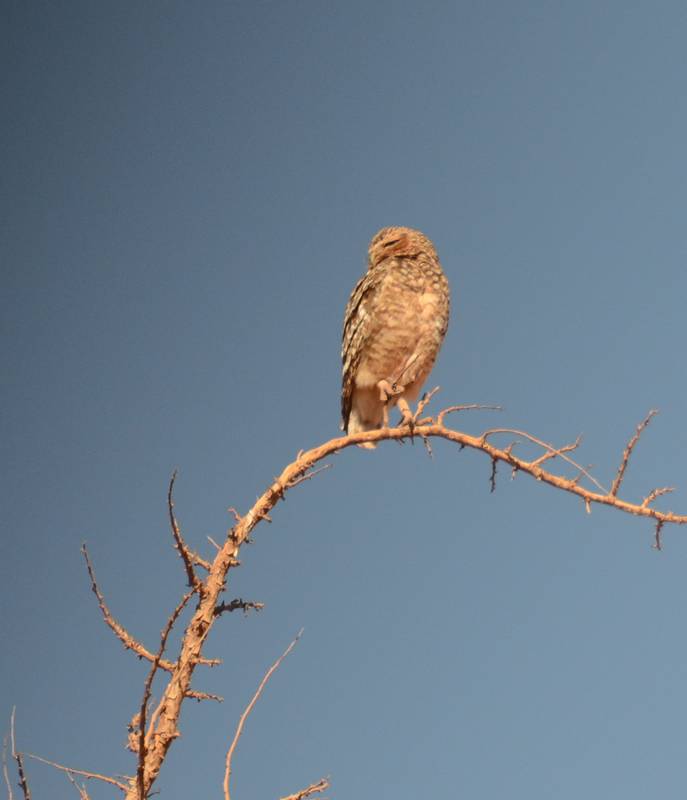
A burrowing owl.
Today was the Valley of the Moon and Death Valley a strangely eroded landscape devoid of life.
The forbidding landscape of the valley of the Moon.
Rock crystals of Salt
This afternoon we thought we would walk into St Pedro. We got lost (one adobe lined lane looks much the same as another!) However the locals were very helpful and our rudimentary Spanish was sufficient. 
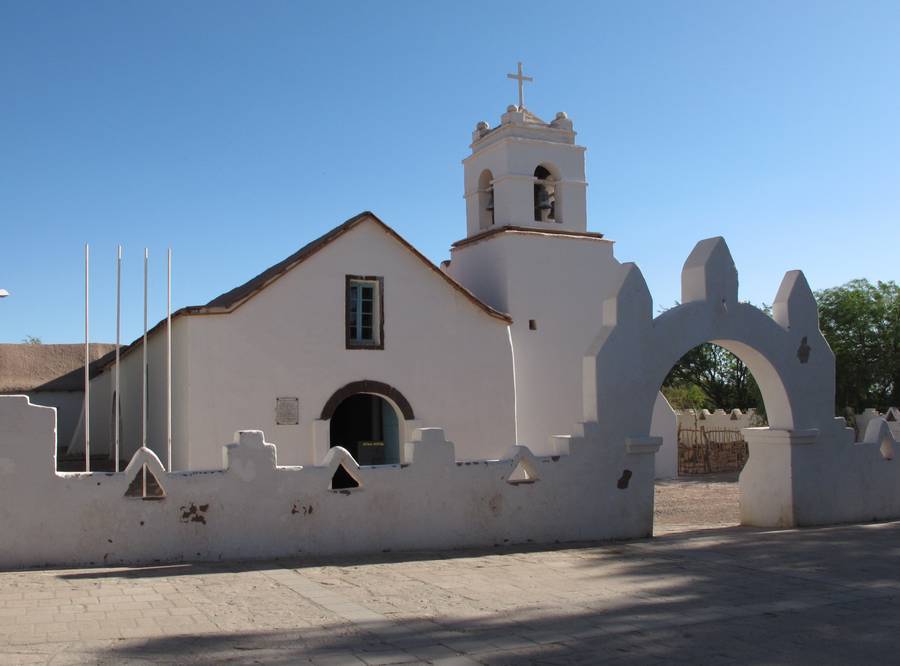
 The church in St Pedro de Atecama
 Statue of the Virgin in St Pedro Church.


Thursday, July 21, 2011

Deer Lake, Newfoundland

 Looking over to Norris Point, near Gros Morne National Park.
The view from Neddies Harbour Inn, Norris Point.
Typical wooden buildings along the shoreline.
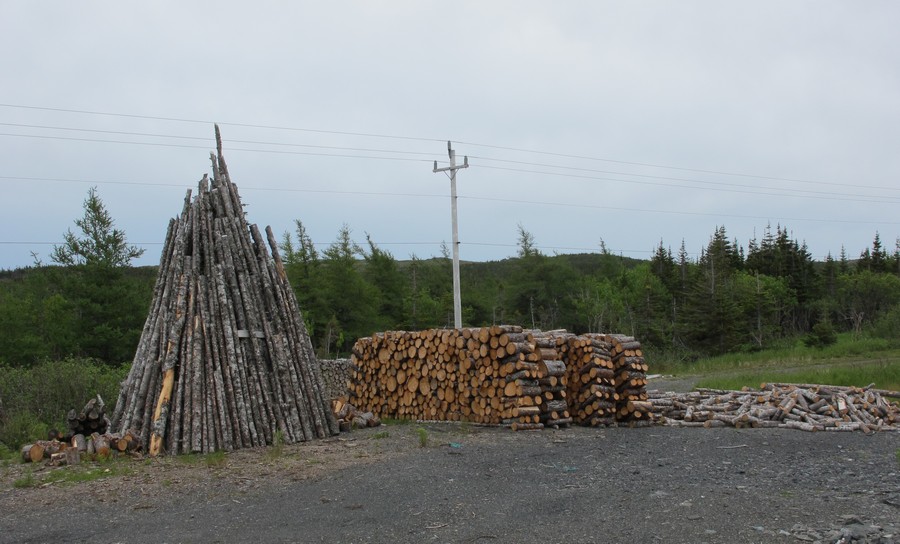
As one drives along the road in Newfoundland, you see lots of these vegetable gardens. They are sometimes many kilometres from a settlement. The fence is to keep the moose out and they are sited where the ground is neither boggy nor stony.
 The other common sight along the road is wood heaps.
 
Thursday morning dawned bright and sunny and so it was a pleasant drive up to L'Anse aux Meadows near the Northern tip of Newfoundland,  stopping only to buy a bottle of wine and a small bottle of Screech, the Newfoundland traditional drink, which is actually rebottled and renamed Jamaican rum.

L'Anse aux Meadows is where a Viking expedition from the Norse settlement in Greenland landed in about 1000 A.D. They came and went for only a few years, before burning and abandoning the camp. They mostly came for the timber to repair their ships. It was an added bonus to find wild grapes and they called the area Vinland.
Map showing the probable route taken by the Vikings from Greenland to Newfoundland in 1000 A.D.
Modern Vikings enjoying lunch of fish and bread porridge.
A Viking loom. I am not an expert in weaving, but I was intrigued to see the weaver worked from the top down rather than from the bottom to the top.

Today Parks Canada have built replicas of some of the buildings and have modern Vikings enthusiastically recreating the past. We easily filled in 2 hours until we had to be at the dock to catch the boat to Quirpon Island where we were staying in the lighthouse keeper's cottage. It is only a short boat ride and on the way we had a close inspection of an iceberg. We were fortunate the sea was calm and we were able to land close to the lighthouse. Sometimes people have to walk the 5 km from the opposite end of the island.

Approaching Quirpon Island.
Cape Bauld Lighthouse, Quirpon Island.

We thought it appropriate to sit on the verandah sipping our Screech (Cooled with 10,000 year old iceberg ice), watching the resident icebergs and trying to spot whales.
View from the verandah of the Lighthouse keeper's house at Cape Bauld, Quirpon Island.
What we were drinking as we sat on the verandah.

After a very hot night due to the overheated building, we were surprised when we looked out the window in the morning to see an iceberg had drifted into view!

As we were there only one night we did not have time to explore the island. The weather held and we were able to leave from the landing near the house. Bryce, the boatman not only took us close by a large (by Newfoundland standards) iceberg. The visible portion was about the size of an aircraft carrier. We also saw a seal relaxing on an iceflow and a humpbacked whale performed for us.
Wildflowers on Quirpon Island.
More wildflowers.
Loading our backpacks onto the boat for our return to the mainland.
A humpback whale shows off his tail.
Getting close and personal with an iceberg.

Main Brook our next overnight stay was not far away, so we went to Conche. Like many places in Newfoundland there was no road in until 1969 and even now it is unsealed. Now fishing is more problematic, the community was looking for alternative sources of income. This area is on the French  Shore, so called because from 1713 until 1904, only the French could fish these waters. They were not allowed to settle and returned home to France every winter.  So a French artist designed an equivalent of the Bayeux tapestry and 13 local ladies embroidered it. It tells the story of the area with much humour and great little details. e.g. Confederation with Canada in 1949 is represented by a Canadian beaver and a Newfoundland dog shaking paws.
Although no photos are permitted of the actual French Shore Tapestry this extra panel was embroidered by local school children.
A partly embroidered panel. The tapestry is on 16 inches wide natural linen and is 222 feet long. The colours of wool used are the same as in the Bayeux tapestry. Twelve local women sat around a wooden frame and embroidered working from sketches sent from the artist in France. It is a most impressive work of art, but Conche is out of the way, so it will be difficult to put it on the tourist trail.

Saturday was showery, but improved over the morning and as we had to return south by the same road we had driven north on, we decided to try our luck again at Western Brook pond and walked in again. The photos below taken during the two hour boat ride will show why I thought the 12 kms of walk worth it!
Western Brook Pond. Fortunately the mist was almost clear of the top of the gorge.
One of many falls at Western Brook Pond.
The tin man face.

Now suddenly it was our last day. We had stayed in Corner Brook and thought we  should find the Captain Cook monument before we left. Our GPS has given up the ghost and the streets were often one way and unnamed, but we eventually found it.

Glynmill Inn, Corner Brook - built in 1924 as an executive guest house during the construction of the pulp and paper mill.
Inscription on the Cook Memorial. It records that his good work in Newfoundland helped him to win the commission to explore in the Pacjfic.

The last excursion was to Big Falls to see the salmon leaping. It was not in the tourist literature, but a Canadian at breakfast had recommended it. There was 16 km of pot holed gravel to get there, but we did see some fish trying to leap the Falls which made it worthwhile. Apparently last week was much better before all the recent rain raised the river level.
Big Falls. We did see a few brave salmon try to leap up, but we did not see any succeed.

This is my last post as we are now back in Australia after an interesting and enjoyable  holiday.

Thursday, July 14, 2011

Gros Morne National Park, Newfoundland

The photographs below missed my last post, but I put them in here, even though we are now well back in Newfoundland.
Waiting for the International ferry from Canada to arrive in St Pierre
Seems like there are still old whisky crates from prohibition days in St Pierre. This one was being used to record visitors votes in a photographic competition at the museum.
Old photograph showing the stacks of whisky crates on the pier in St Pierre during prohibition.

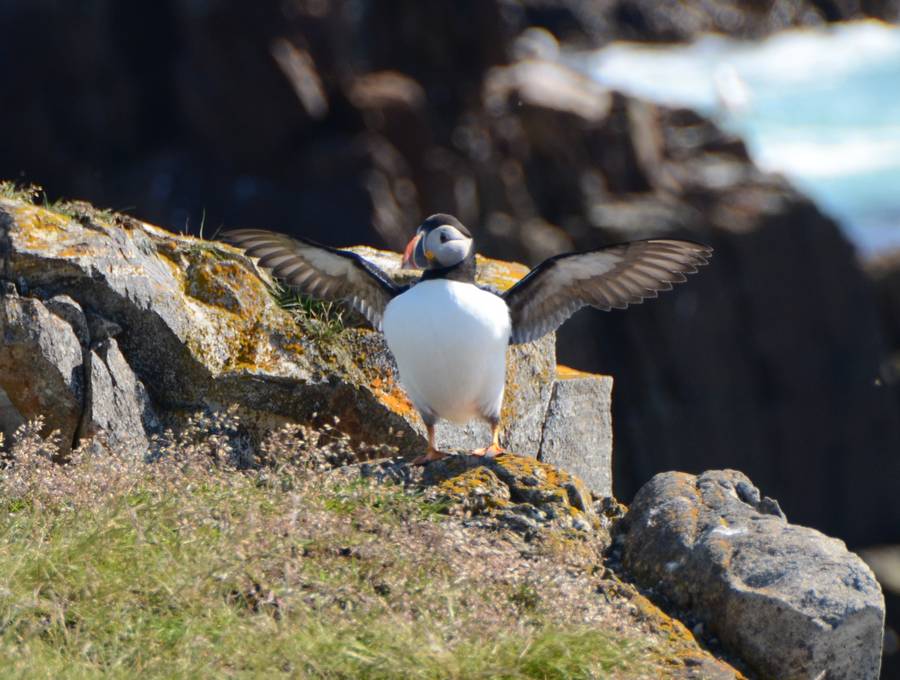
Well, the Newfoundland weather has caught up with us. Last Sunday when we were on the Bonavista Peninsula it blew a gale and rained intermittently. After exploring the Heritage area of Trinity, we tried to walk out on the cliff at Elliston to see the puffins, but the wind was so strong it was too scary. However Monday morning was bright and clear and calm, so we went back to the puffin site and were glad we had returned.

From Trinity we explored around the Twillingate area on our way to our next stopover at Bluewater Lodge. It was log cabin style very comfortable and nice people, but in the middle of nowhere - in the forest by a lake, with no real views.

Tuesday morning it was raining and it hardly stopped all day. At times it was just sheeting down and the water was hardly running off the highway. We thought it a good day for museums and coffee shops.

There was a very good small museum in Grand Falls-Windsor and as part of the $2 entrance fee there was free entry to the Loggers museum in the forest just outside town.

This morning when we woke it was foggy and still inclined to rain. We were booked on a boat trip into West Brook pond which apparently is a spectacular fiord. It is a 3 km walk into the boat dock.

Anyway we thought we might as well walk down the track to the water. it was a pleasant walk and there were some wildflowers, but the boat trip was cancelled as the fog did not lift at all and the maximum temperature was 9. Apparently the weather means the trip is cancelled about twice a week on average and this is summer!

Everybody keeps warning us about moose on the road. Someone introduced 2 pairs in 1878 and now there are more than 120,000 on the island and they cause a lot of fatal accidents. They are big!

Anyway cross your fingers for tomorrow.
 L plate driver - Newfoundland style
19th C house in Trinity. The internal walls are vertical boards (spruce?) covered in wallpaper. There are no studs so they are less than 2 inches thick.. I think it is called balloon construction
 Crazy patchwork quilt.
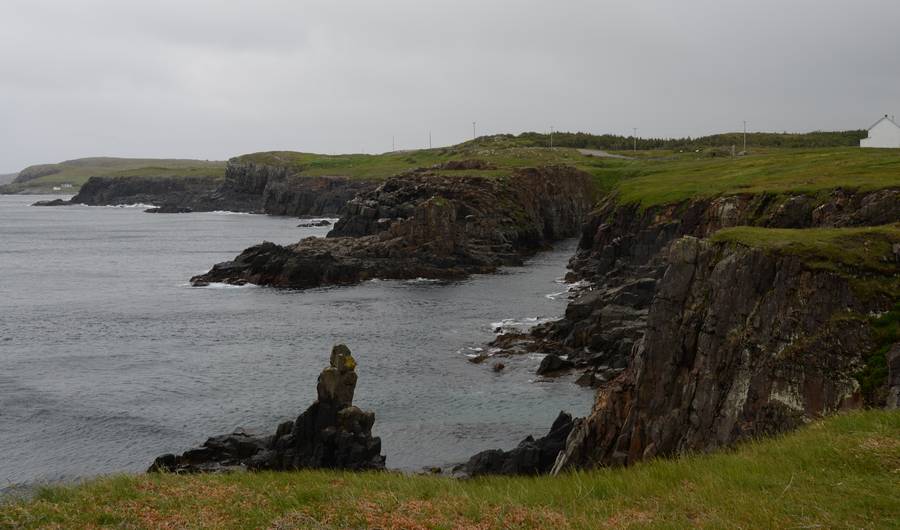
Typical indented rocky Newfoundland coast. James Cook spent 4 years in the 1760s charting these bays.
 Last Sunday we saw how angry and dangerous the sea can  be.
The view from our room at the Fishers' Loft Inn, near Trinity.
 The view from the dining room at the Fishers' Loft Inn
 A puffin spreading its wings. They look very ungainly in the air as they beat their wings rapidly.
 Another puffin poses. They are comical appealing birds, but much smaller than I expected.
 Long Point Lighthouse, near Twillingate. There are no shortage of lighthouses, some still manned.
 The Loggers Museum. You will have to imagine the mosquitoes.
 Interior of one of the huts. As you can see, a pretty Spartan place to live for months at a time.
 The view from Neddies Harbour Inn, Norris Point - just outside Gros Morne Park
Canadian Burnet(t?)
 Bakeapple -like a Newfoundland wild raspberry. This one is unripe. When ripe they are orange.
 Arethusa or Dragon's Mouth
 Late afternoon on Wednesday and the fog has not lifted.