Saturday, September 27, 2014

Palmweg, Damaraland, Sept16th,2014

After leaving Windhoek we had a long day's drive through Damaraland The Damara are one of the principal ethnic groups and their women along with the Herero women wear 'missionary dress' - long voluminous skirts and distinctive turbans. It is nearly the end of the dry season and the country is very dry and we saw few people but some interesting geology. Finally we arrived at Palmweg lodge. It is aptly named being in an oasis of palm trees. As with most of the lodges the accommodation is in thatched huts scattered around with few signs. Who would guess Elephant Walk would lead to the dining room!

In the morning 16th? we went for a game drive. Palmweg Concession is 5,500 sq km and we saw heaps of zebras and springbok and a couple of hyenas. There were  guinea fowl, Ruppels Kophaan etc. The dominant vegetation is Euphorbia Damarama which is eaten by kudu, black rhino and steenbok but is very poisonous to humans

That evening at dinner one of the guides told us there was an elephant at the fence very close by so we all trooped out to see it.

17th Sept We left Palmweg at 7 and arrived at Tosharu Lodge just outside Etosha at 6.30 = 800 km drive. Howeve we did make 3 stops - first at Twyfelfontein (Doubtful Spring) where there are thousands of rock engravings done by the Bushman or San people several thousand years ago. On then to the Organ pipes rock formation - think Giant's Causeway. But to get there was about 12 km of horrendous corrugations. The third stop was a petrified forest = pine washed down in a huge flood from Central Africa in the distant past.

Tosharu Lodge was very nice with lots of bougainvillea but the lighting was far too romantic - we could not see a thing. However the buffet dinner was excellent springbok meatballs and kudu stew. As always accompanied by delicious salads and good soup for starters.

18th Sept.

Up at 5.30 and on the road before 7. Etosha was proclaimed a National Park in 1906 and was originally 100,000 sq kms. It is now only one quarter of that size.

Our first sightings were zebras galore and springbok. The zebras in this area are Burchell's and their stripes go right around their bellies.Then we saw 2 white rhino and some impala. Best of all was the Neubroni waterhole with a Noah's ark of animals all drinking. Eventually even the wary giraffe dared to drink.

19th Sept.

Another long days drive to Rundu on the Angolan border. The vegetation is different and since cattle farming has become less profitable the bush is taking over the land.

We stayed at Kaisosi Lodge on the Kaivango River complete with resident peacock.

20th Sept

Today we crossed into Botswana after first paddling through the foot and mouth mat and soaking our spare pair of shoes we carried on into the watery world of the Okovango delta.
A two hour speed boat ride took us to Inkwazi our houseboat home for two nights. 


Roadside stall
Dutch Reformed Church
Sunset near the Palmweg lodge
Zebras in the dawn light during our first early morning game drive.
Giraffes do tower over everything else.
A spotted hyena surveys the scene.
Some of the palms which give Palmweg Lodge its name. I think they may be makalini (sp?)
More giraffes posing.
Annalies explaining some of the Bushman rock engravings at Twyfelfontein (doubtful spring).There are thousands of the engravings and they include - rhinos, giraffes, waterholes etc and they date back thousands of years.
Pretty pink flowers at Twyfelfontein. One book called them pink eidelweiss.
The rather comical secretary bird which is about 80 cm tall.
The peculiar Wallachia plant which lives for a hundred years but has only two leaves (I need to check my facts)
More wildlife at Twyfelfontein
 Emma and Alfred and the truck
The connection has deteriorated so I will be back to finish this post later.
Seems faster now so  I will continue.
 Donkey cart on the road to Etosha NationalPark.
 An iconic tree in Etosha National Park.

White rhino
 Wildebeest

 
Impala

Kori bustard.  
 Easy to see why kudu were hunted for their antlers.

Social weaver bird nest. They are tiny birds but the community nests are huge
Possibly a white browed sparrow weaver bird
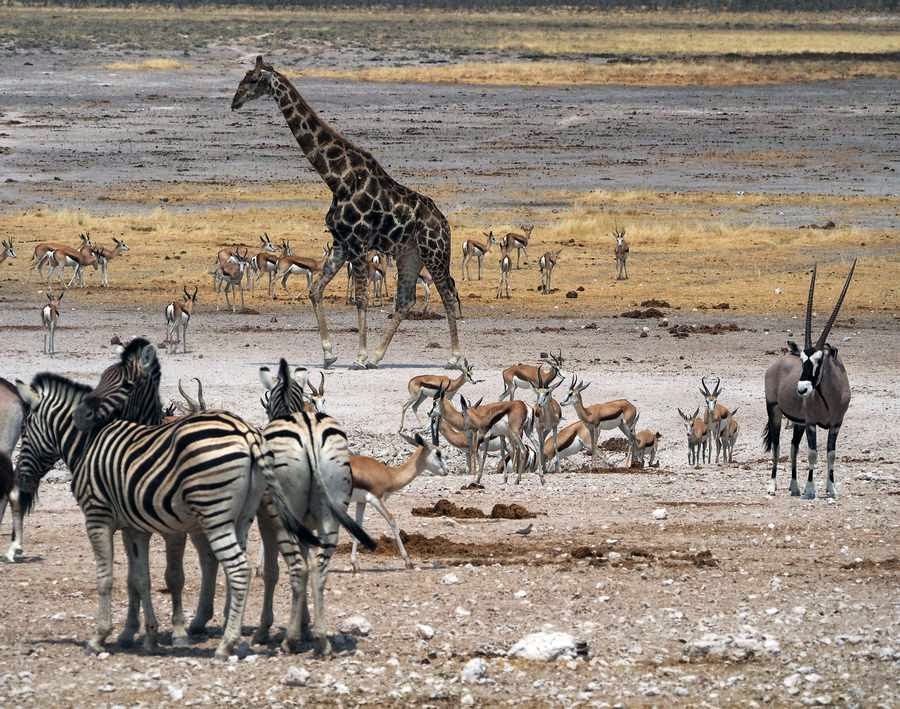
At the Neubroni waterhole in Etosha.
Neubroni waterhole again. It is almost biblical the different species drinking together although the giraffes were very wary.
However the rhino had no trouble keeping his personal space.
The ostriches were a bit feisty.
A lion surveys the waterhole looking for possible dinner.
A doll dressed as a Herero lady
Alfred inspects the truck. We did have a leaking tyre and as each tyre weighs 180 kg that makes life difficult.

Monday, September 15, 2014

Windhoek, Namibia, 14th Sept, 2014

We spent yesterday in Swakopomund. Although it is the second city in Namibia, the population is only 16,000, but there are 2 adjacent townships - Modesa and DRC (Democratic Resettlement Community) with at least another 26,000 people. The South African administration enforced segregation in 1960 and although since independence in 1990 anyone can live anywhere there is not a lot of mixing.

The town has fine old colonial buildings and still a distinctly German feel and look. The people are mostly Christian and English is the only official language, but most people speak 5 or 6 languages and some are the click languages like the bushmen.

Flamingos hardly need identifying
 
Cormorants
 
 Beach bar in Swakopomund
 Self  explanatory
 
 Typical old buildings
 
Lots of different colours and varieties of pigface
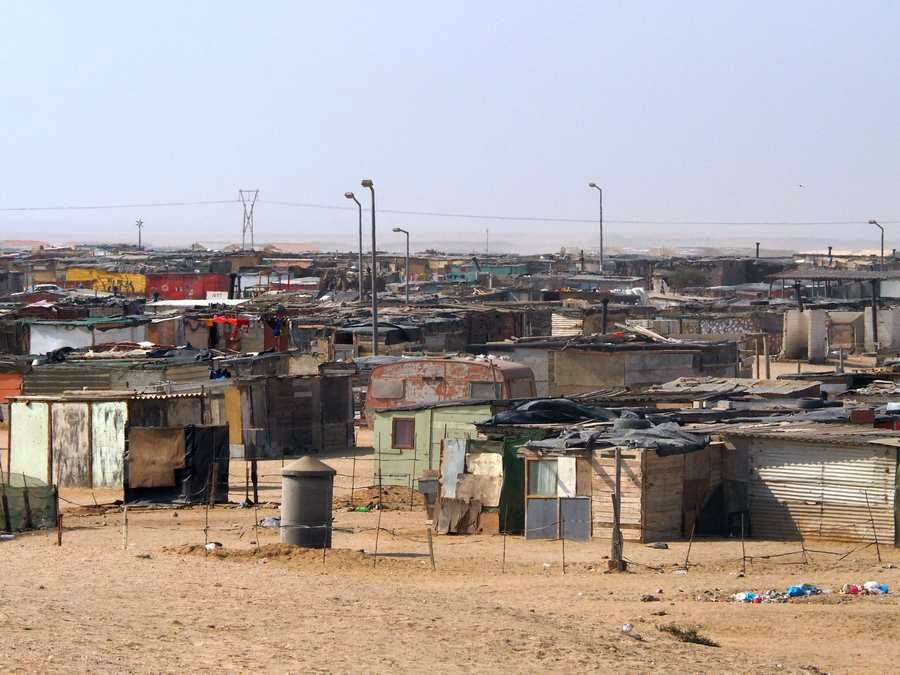
 The township of Modesa. There are different sections as the South African govt gave the smallest tribe the biggest houses.
Price list in a Shebeen or bar in Modesa. $1 Namibian is about 10cts Aus
Clientele In the bar.
Some people earn good money working for Rio Tinto in the nearby Uranium mine but prefer to still  live in the township as there is more community spirit and street life.
Street market.
All sorts of entrepreneurial businesses
 
Termite mound Namibian style.
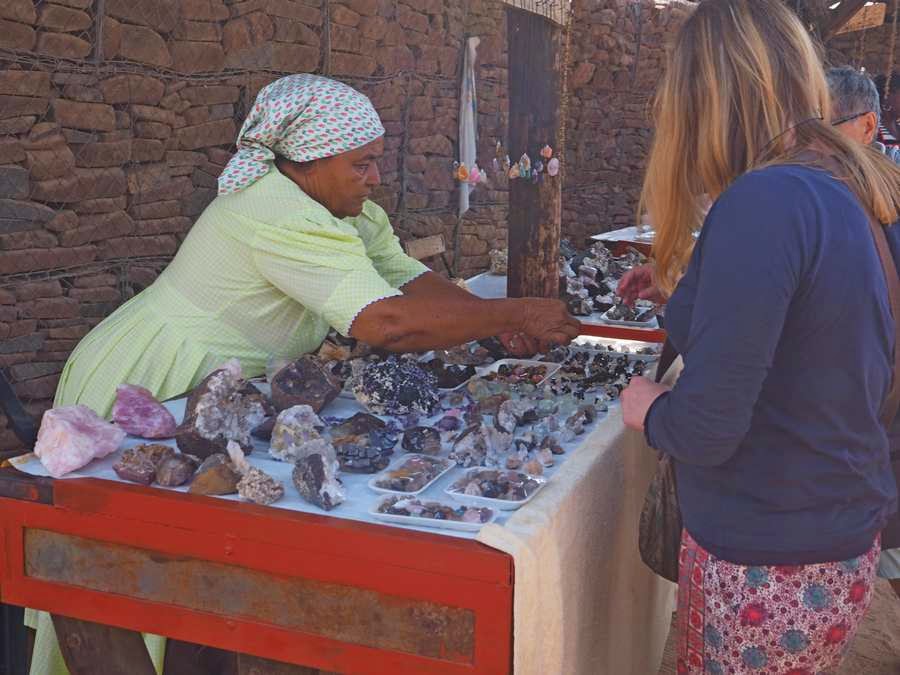
 The town of Chrystal - mostly black tourmaline, amethyst, rose quartz and agate.
 
 Helena one  of the staff at Roof of Africa hotel in Windhoek shows off her fishtail pushback hair style.

I think this might be the last  Internet before we get to Victora Falls  about the 27th September and by then I  anticipate I will have plenty to add.. 

Saturday, September 13, 2014

Swakopomund, Namibia, Sept 13th, 2014

A couple of photos which missed the boat.
Nesting gannets near Lambert's Bay
 
 Mandela's Gold,a new variety of Strelitzia bred in Kirstenbosch Gardens, Cape Town.
 We left Cape Town a week ago. The drive near the coast was through an expanse of wildflowers until we stopped for lunch at Muisbosskerm a fish reataurant right on the beach. First course was absolutely superb mussels and then we used the shells as cutlery to eat more fresh fish and springbok stew followed by fresh baked bread and home made apricot jam washed down with good South African wine at $2.50 a glass.

On then to Lambert's Bay where thyere is a huge gannet colony on an island connected by a short causeway. Lambert's bay had no power. It was supposed to come back on at 6, but at 9 we gave up and went to bed (Power finally came on at 4 am). Next day we crossed into Namibia.  The immigration official studied the stamps in our passports very carefully to make sure we had not been in west Africa.

We stayed in Felix Unite a lovely lodge on the Orange River - thatched cottages with views.On Tuesday morning we started the day with canoeing on the Orange River. I had never been in a canoe, but Dave - a NZ fellow and I safely negotiated the rapids and it was quite idyllic.
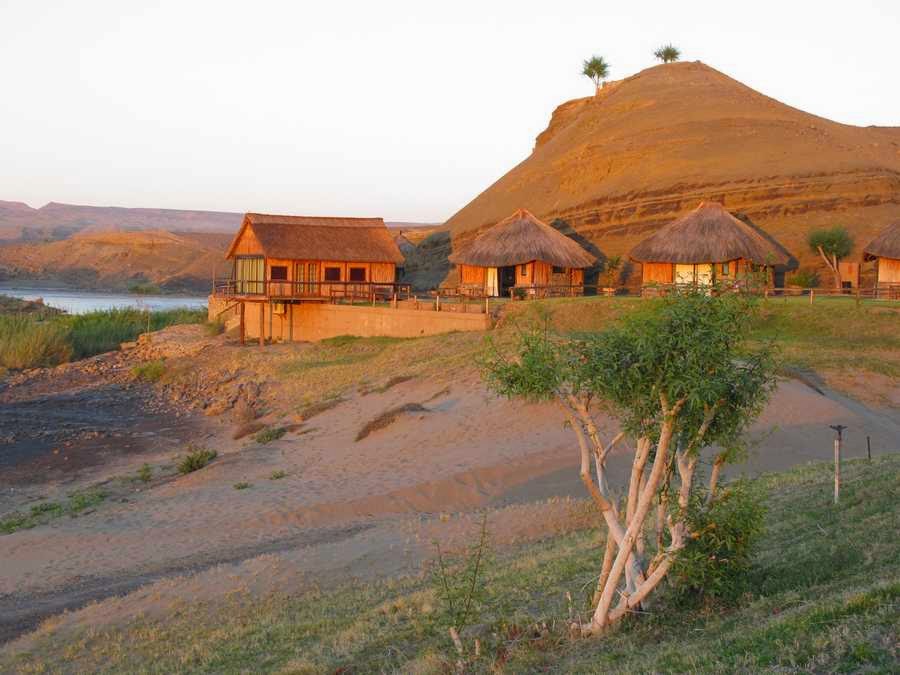
Felix Unite Lodge on the Orange River
Canoeing on the Orange River
In the afternoon we drove to Fish River Canyon - very spectacular and saw the sunset.
Fish River Canyon
Namibia is twice the size of France with a population of little more than 2 million and miles of gravel roads. sheep farms - mostly karakul sheep and tiny towns such as Helmeringhausen which has 16 inhabitants. Here the hotel is one side of the road and the service station and shop on the other side, but they do not talk to each other.

After a long days drive we came to Sossusvlei and are staying on a farm. Water is very scarce but there is a small patch of water in from of our balcony where springbok come to drink.

In the morning we were up at 5 to be at the gates of the National park before they open at 7. This is the area of the spectacular orange sand dunes as once featured on a Windows screen saver. We saw oryx and ostriches and a jackal.
Waiting for the park to open
Climbing the dune on the way to Deadvlei. There is an easier way to get there!
Dead vlei. The trees maybe 500 years old. In the desert climate decay is very slow.
 Dead vlei. The trees maybe 500 years old. In the desert climate decay is very slow.
 
An oryx strides out along the road to Sossusvlei.
Fancy some snacks!
Ice flowers
Solitaire (near the tropic) population 92.
 The famous bakery in Solitaire
Picnic lunch of apple pie from Moose's bakery.

Friday we drove onto Swakopomund Namibia's second town. It is near walvis Bay an important harbour and so like Port Hedland there is a line of cargo shipson the horizon.Also there is quite a lot of new luxury accommodaion going up along the beach.

The German influence is strong and the architecture and food reflects this. English is the official language which makes it easy. Forgot to say we saw our first zebras and there are flamingoes just outside town.

Friday, September 12, 2014

Sossusvlie, Septembet 11th, 2014

Sorry there have been no posts but this is the first Internet since Cape Town and it is woefully slow. The trip is going well but a bit exhausting

Will post when I get an opportunity

All for now

Friday, September 5, 2014

Cape Town, South Africa, Sept 4th, 2014

South African Airways looked after us well, but after an 11 hour flight I did not enjoy the long, long walk around Johannesburg airport. However we arrived safely in Cape Town and the hotel is very nice and we can see Table Mountain from our window. Yesterday afternoon we went to the Waterfront - a refurbished docks area reminscent of Fremantle

Today , Pieter who I had booked over the Internet came to take us for a day tour. It was a glorious day so we started by taking the cable car to the top of Table Mountain and then drove the spectacular coastal route via Chapman, Peak to Cape Point. The Fynbos flora is very reminscent of the Albany area W.A. and it even smells the same.

Last night we took a short walk and found a nice Italian restaurant where pasta (very good) was about $6 and a glass of excellent red wine about $3. Coffee also is cheap and good. Our restaurant tonight was thai and the dishes were good, but none of the staff looked as if they had any connection with Thailand.

Just a few pictures
The view from our hotel window.
   
The wheel at the waterfront complex.
 
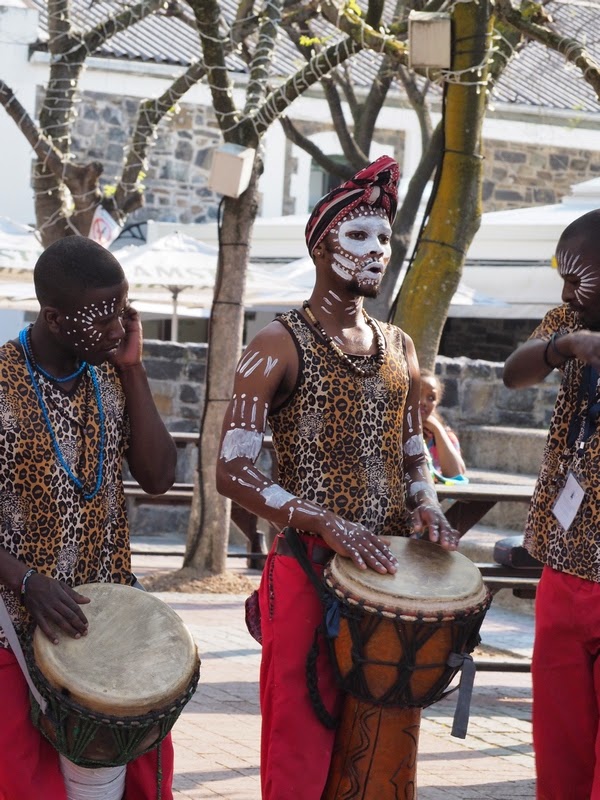
 Entertainment on the waterfront.

Colourful houses in Bo Kaap
Table Mountain cable car.
A dassie comes out of its hole on Table Mountain.
A construction worker in Table Mountain National Park.
One of the African or Jackass penguins at Boulder Beach. They are very friendly or should I say curious like all penguins.
Just one of many Fynbos wildflowers out now.
Spectacular coast at Cape Point but no Flying Dutchman today.


Saturday, August 30, 2014

Off to Africa August 31st, 2014

Winter is nearly over and so I am coming out of hibernation. We leave for Cape Town on Tuesday.

Here is the map of our intended tour. So watch this space.