Saturday, May 3, 2014

Karakol, Kyrgyzstan, May 3rd.

April 30th. We arrived in Bishkek at 4 in the morning and were immediately aware we were in a different country. Within 20 minutes we had collected our luggage, had our passports stamped and walked through the Green "nothing to declare" customs lane and were off to our hotel.

Bishkek is about 1 million people and has just turned green for spring. We noticed a lot of cars are right hand drive Japanese 2nd hand imports although traffic drives on the right. We first visited the Frunze House museum, a 19thC thatched cottage and then walked through Oak Park, a lovely park with lots of sculptures left after a big Soviet sculpture  exhibition in about 1980. The State History and Art Museum had a lot of interesting exhibits and stunning views of the mountains from the windows. The carpets here are mostly felted. All the textiles have markedly different patterns from Uzbekistan.

We finished the day in the Osh Bazaar which is pretty lively and we were able to stock up on dates and nuts.

May 1st. Today we left Bishkek and drove first to the BuranaTower a 10thC brick structure on the site of  the more ancient Sogdian city of Balasagun. Nearby is a collection of balbals or Turkic totem-like stone markers.
We drove onto Cholpon-Ata where we stayed in a resort hotel - not quite our cup of tea. Apparently rich Russians and Kazakhs come here for Lakeside holidays. Lake Issy Kul is a huge alpine lake at a height of 1800m. We were more interested in the petroglyphs some dating back to 1500 B.C. but mostly from the Zoroastrian period 6thC B.C. to 1stC A.D. There is a large field of glacial boulders and we wandered around and found a few and also some stone circles.


Sculpture in Oak Park, Bishkek
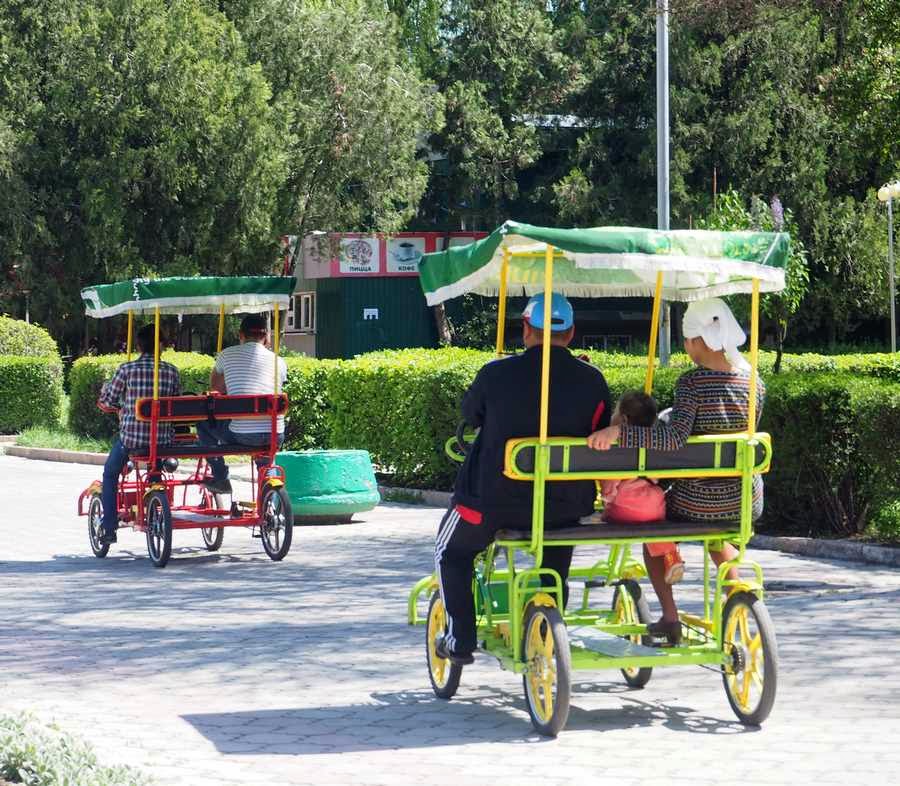
Spring has arrived in Bishkek and locals were enjoying the sunshine.
A Zoroastrian ossuary in the State museum.
Kyrgyzstan wall hanging
Patchwork!
Fetishes all featuring vicious claws.
 Mr Minute in Osh Bazaar, Bishkek
Plenty of competition between bakers.
 Like a dried yogurt ball?
A broom seller in a Kyrgyz felt hat

10thC brick Burana Tower
Petroglyphs at Cholpan Ata.
Much simpler mosques here and sometimes I need to check whether it has a crescent or a cross as the architecture is similar to local orthodox churches.
 More up market mosque.
 This mosque in Karakol belongs to the Dungan community - a Chinese Moslem people who fled China in the 19thC.
Holy Trinity cathedral, Karakol.
Not a country for vegetarians!
Balbal (Turkic totem like stone markers) from 6th - 10thC.
Leather container used by nomadic people.
Stunning mountains.

Thursday, May 1, 2014

Fergana Valley, Uzbekistan, April 30th

27th April:   We left Samarkand to return to Tashkent - a 4 h drive across fairly flat country which would be almost desert but is irrigated for cotton and wheat. We stopped to buy strawberries on the roadside but it was not a noteworthy drive.

The following morning we left for the Fergana Valley. It has always been known as one of the most fertile regions in Central Asia and today 8 million or one quarter of Uzbekistan's population lives here. 


In the 19thC it was under the Khan of Kokand, the largest of the 3 khanates who ruled present day Uzbekistan and beyond (the other two khanates were Khiva and Bokhara).  It is the most conservative and Islamic part of Uzbekistan and is also known for its handcrafts particularly Rishton pottery and ikat silk weaving at Margilon.

It was a long drive to Fergana and in parts a very slow road over the Kanchik  Pass at 2267m  with major roadworks and where there were still drifts of snow. Unfortunately because of the industrialization the air was not clear, even though many factories are now derelict.

On the way there lots of people planting spring flowers along the roads and in towns at the roundabouts.

On 29th April we returned to Tashkent  but it was a very long day. We started at 8.30 and visited various sites around the Fergana Valley until about 3 pm when we finally set off for Tashkent arriving there after 9 pm.
It hardly seemed worth checking in as we had to leave the hotel at 11 to catch the 2 a.m. flight to Bishkek, but we persuaded the hotel to provide us with a breakfast box at 10.40 p.m. which we ate in the lobby.
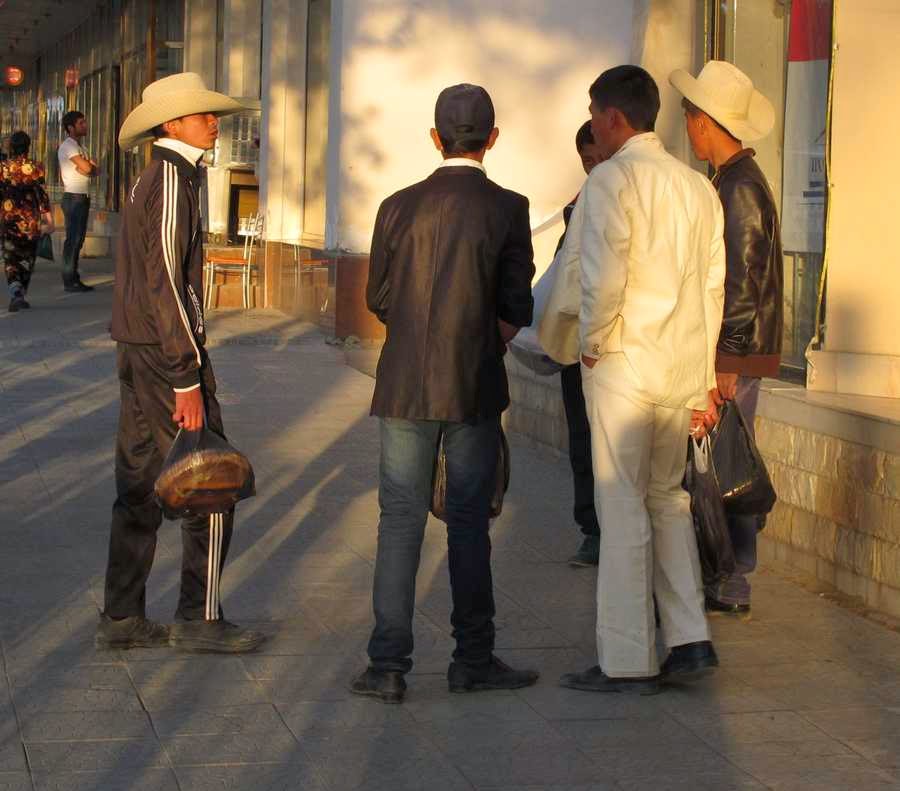
 A final Samarkand picture - the Wild West..
 
 Dinner in a posh yurt in Tashkent and very nice it was.
 
A group of Uzbeki men enjoying lunch in a roadside cafe along the Fergana Valley road.
 
 This aivan (portico) in the Jumi mosque in Kokand is supported with 98 red wood columns  brought from India at the end of the18thC.
 
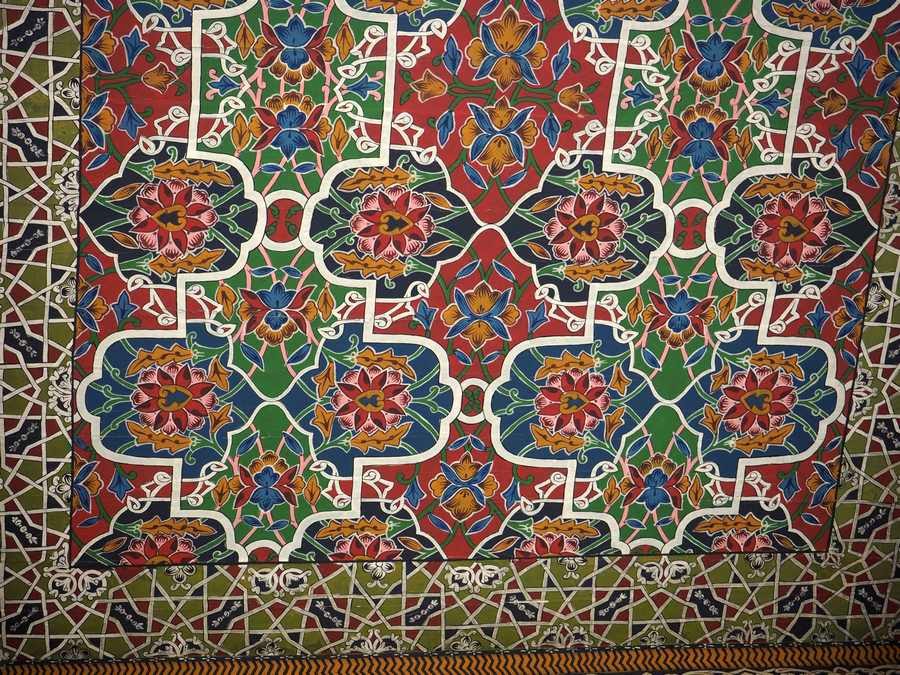
 Gorgeously painted wooden ceiling in the Aiwan.
 

 Bibi our guide watching a potter at work in Rishton. The local clay is of an exceptionally high quality and requires no additives. The traditional green and blue Islamic designs are very attractive.

 Hand painting tiles in Rishton.

We visited the Yodgorlik Silk Factory in Margilon. This girl is plying the silk from about 30 cocoons.
 
 The vats for boiling the dyes (mostly natural)
 
 Laying out the warp threads ready for weaving. A modern innovation is to use sellotape instead of cotton thread to tie the bundles of thread together.
 
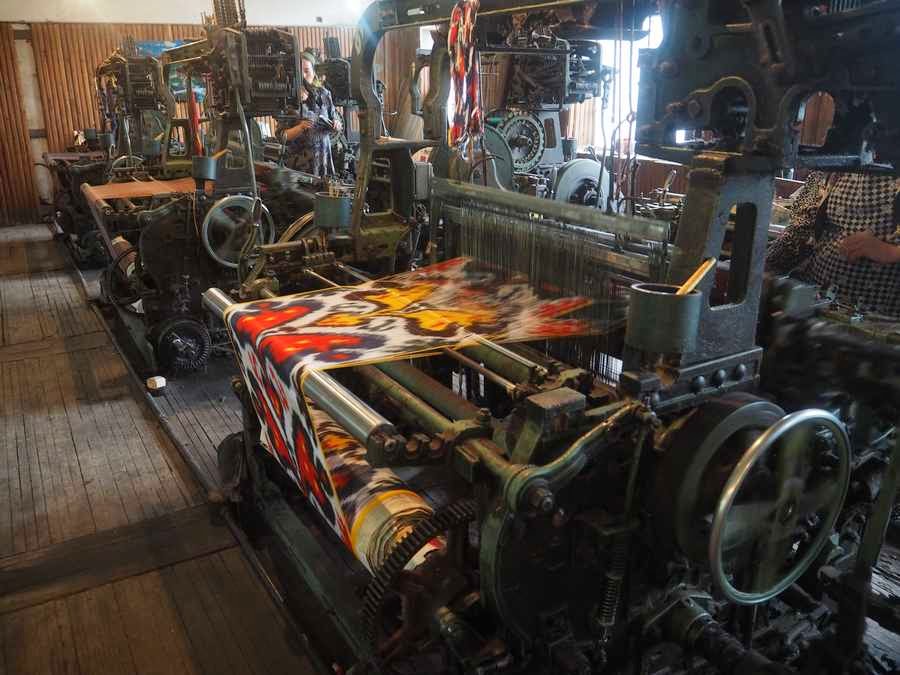
Machine weaving Ikat. This is much faster than hand weaving, but also much noisier!
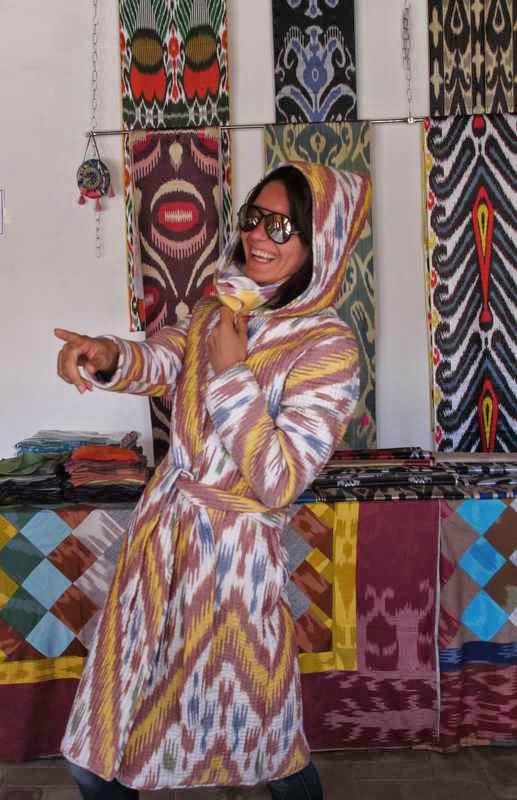
Bibi models a padded cotton Ikat coat.
The Jumi mosque in Andijon survived the 1902 earthquake. Its design and its minarets are more Indian or Persian  than Central Asian.
More conservative women's dress in the Fergana valley towns.
Vegetable/Herb sellers in Andijon market.

Sunday, April 27, 2014

Samarkand, Uzbekistan, April 26th, 2014

24 Apr (Thurs):   We left Bukhara in rain and it rained on and off as we took the longer southern road to Samarkand.  The first 4 hours or so was through flat desert with some irrigated land growing wheat together with other parts ploughed ready for cotton.  As we got close to Shakhrisabz the country improved and there were lots of orchards.  Shakhrisabz is Timurlane's (see later) birthplace and he built himself an enormous palace here.  Now there are only the ruins of the entrance portal but they are still impressive.

We continued to Samarkand over a 1,700 m pass.  There were boys selling bunches of wild tulips and the driver stopped to buy me a bunch.  At the top of the pass we tried the wild rhubarb on sale at a stall but it was too cold, wet and windy to linger.


Alexander the Great was very impressed with Samerkand and it must have been a fabulously city for a long time before Ginghis Khan obliterated it in 1220.  In 1370 Timurlane made it his capital and re-built it in grand style using artisans from all over his empire which stretched from Turkey to India.  It is these 14th C buildings which bring people here today and which impressed Marco Polo.  After Timurlane died his grandson Ulegbeg reigned for 40 years.  He was a scholar and astronomer and we visited his observatory and interesting museum depicting his scientific work.


Samarkand has extensive parks together with mosques, madressahs and mausoleums galore.  We are staying near the university and had lunch in a Uzbek equivalent of a fast food  joint.  We found the local beer store (actually 3 side-by-side).  They do a roaring trade - we saw one customer buying 3 cases of vodka.

As usual we like wandering around the bazaars, although the few gypsies are annoying. There are also old women selling fine handknitted lace woollen shawls (Orenburg?) now for the photos:-


The Malika Prime in Samarkand with a good shower and a very good breakfast.
Wild tulips. They are as big as cultivated ones.
Ak Saray Palace, the 40m high ruins of the portal to what must have been an incredibly huge palace which Timur built for himself
Tilework at Ak Saray palace in Shakhrisabz
Kok Gombaz mosque in Shakhrisabz
 

The palm trees on the interior tiled walls were left by the Indian and Iranian designers.
Wild tulips for sale along the road.
Looking down a shady avenue to a seated statue of Timur.
Exquisite tiling in the Gur e Amir mausoleum where 2 of Timur's sons and 2 grandsons are buried. When the grave was opened in 1941 it was found Timur was lame and that his grandson Ulegbek had been beheaded.
 Outside view of the famous Registan which has huge 14thC buildings on three sides
Another view of the Registan complex.

The Sher Dor Madressah has lions over the portal although they look more like tigers.
 A musician demonstrating Central Asian musical instruments.There are many stringed instruments with various numbers of strings and also a flute.
 Photograph of the Registan in the 19thC. Stalin started (or at least encouraged the restoration starting in 1930.
Giant marble Koran stand at Bibi Khanym mosque (She was the wife of Timur.
 The remains of Ulegbeg's sextant. His observations were remarkably accurate.
Sorry this is out of focus but it shows he calculated the length of the year to within one minute.
Daniel's tomb still popular with Jews, Christians and Moslems. Timur brought his remains here from Susa (Iran) - for good luck!
Part of the 7thC Sogdian fresco at Afrosiab an older Samarkand.
 Zoroastrian ossuary in the Afrosiab museum.


Market in Samarkand.