Saturday, April 26, 2014

Bokhara, Uzbekistan, April 23rd

Last Monday (21st) we left Turkmenistan by the Farab border crossing where there was a great lineup of trucks.  With our guide Murrad on hand the Turkmenistan side was easy and then there was a shuttle bus which we shared with some Swiss but it only went as far as the actual border where there was the first Uzbek passport check.  We then had to walk dragging our cases for over 1 km to the immigratiion and customs building.  We had to fill in a Russian language customs declaratiion but they did lend us a form in English that had been previiously filled in by a  German tourist which was very helpful.  Eventually after 2.5 hours we were on the road and arrived in Bukkara at about 7 pm.

Our hotel, the Komil is a restored/refurbished courtyard house of a 19th century merchant. It is a bit of a labyrinth with at least 3 courtyards but is very nice.  The other guests are mostly French - indeed most tourists seem to be French, German or Italian and I.have never before been asked if I was Portuguese!

 
On Tuesday morning (22nd) we started our tour of Boukara by visiting the Mausoleum of Samamid built between 892-943 AD with its fine brickwork.  Next stop was Bolo Hauz (1712) with 20 columns reflected in a pool.  Across the square is the Winter Palace built on the site chosen  by Cyrus in the 6th century BC.  The 19thC emir was notoriously cruel and it was here in 1842 that two British army officers were publically executed after digging their own graves.


. Then on to Poi Kalan with its minaret built in 1127.  Here Job is supposed to have struck the ground with his stick from where a water supply sprang up.

The city is much more geared to tourists than anywhere else we have been and there are a lot of stalls selling ikat fabric, embroidered  items, wood carvings, miniature paintings, puppets and so on.

The women in Bukhara dress quite differently from those in Khiva.  Here the most common outlfits are matching above the ankle slacks and dresses in bright colours with a lot of sparkles.  The men wear the square skull cap.  Pilgrimage  is a popular pastime often to mausoleums of imam/sufi saints.

Bill has been pleased to find that you can buy draught been in empty water bottles filled while you wait for about $1.70/l and it is very good.  I find the dried apricots and various nuts, pistachios, peanuts and walnuts very good but bananas from Equador are $1 each.

 The plain street frontage of the Komil hotel, Bukhara
Our windows on our courtyard.
Mausoleum of Samamid built between 892-943 AD
Not bad brickwork 1100 years ago!
Typical local dress in Bokhara.
Old style street butcher.
More modern refrigerated butcher.
Some of the 20 columns of the Bolo Hauz (1712)
 Bolo Hauz ?
 Lion in a courtyard at the Winter Palace in Bokhara.
 Walls of Khiva.
 Fresh Russian style Bread
Cauliflowers for sale.
 
Tilework at Poi Kalon a 16thC mosque.
Silk carpet weaving. Girls must be 16 at least.
Not sure of the function of the handles on the furnace. They were forging knives.
Madressah Nodiz Devon begun in 1622. Note the birds on the tiles.
Bottling draught beer at a very reasonable price and a good product.
Bokhara puppets
Mulberry tree on the courtyard of a madressah
The dining room of our hotel.
Shortage of labels- will follow later
Brass Chandeliers at Bahauddin Naqshbandi a popular local pilgrimage site
 Pilgrims circling around an ancient mulberry tree at Bahauddin Naqshbandi.

Pilgrims relaxing and praying at Bahauddin Naqshbandi.
 The  Emir's Summer Palace at Sitorai Makhi Khosa built about 1900 in a mix of Russian and central Asian styles.
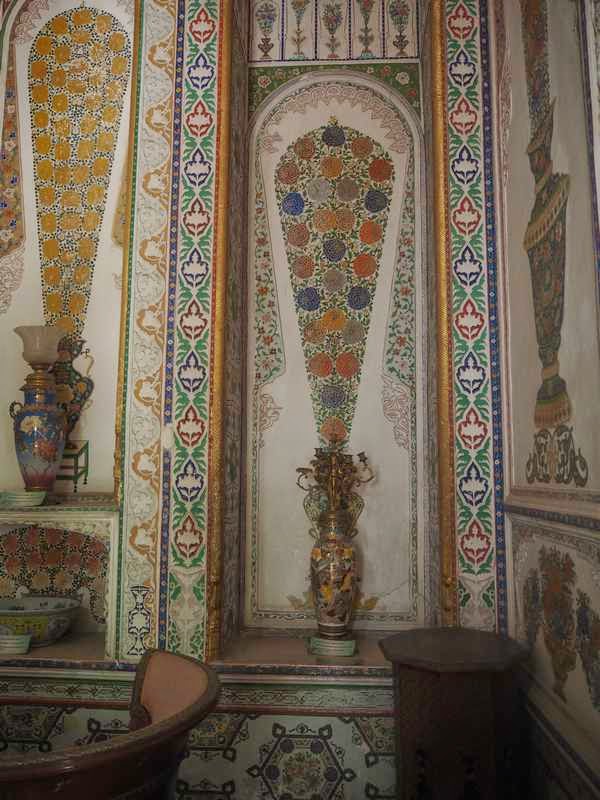
 The white room where the mirrors are decorated with white plaster.
 Miniatures on "silk paper" (actually mulberry bark paper)


There are still peacocks in the grounds of the Emir's palace but no longer the extensive menagerie he had. We were too early for the roses but there are heaps of rose bushes.
Chor Minor

Wednesday, April 23, 2014

Turkmenistan Part 2 April 23rd

Saturday 19th April was a long day's drive to Mary (pronounced Murray). Our first stop was at Anew where evidence has been uncovered of very early cultivation of grain but the main thing visible today is the ruins of the 15thC mosque of Seyit Jemal.
 Then as we drove further east we were close to the Iranian border just over these mountains
.Further along the road we came to the ruined 18thC palace and fortress on Nadir Shah.


Sheep grazing by the walls of the fortress.

Walls of Nadir Shah's fortress.

Lunch of fresh fish for the fish eaters and ravioli for Bill.
We finally arrived in Mary and this mosque was next door to the hotel.
Sunday 20th April and we drove to Margush. It was a sandy track and we were in a Nissan pathfinder. I forgot to say Uzbekistan has a car industry - a joint venture with GM making Chevrolets so we travel in style in Uzbekistan. Turkmenistan has no car industry so we travelled mostly in new Toyota Camrys and Avalons. Anyway getting back to Margush or Gonur Depe it is an amazing archeological site dating from the Bronze Age. The site is huge and you wander at will around it. The day we were there there were three other tourist groups (each of 2 people) and locals who had come out for an inspection including some men who had their picnic  lunch next to us and invited us to drink a vodka toast - which we did.
Baby camel and Mum on the way to Margush.
 
 General view of the excavations at Margush. They had considerable pottery making skills and there are vast quantities of finely crafted ceramics. Their kilns were sophisticated. They were Zoroastrians (fire worshippers) or proto Zoroastrian and carefully collected the ash from the kiln fires.
 Even then horses were significant as shown by this grave.
Our picnic friends in Margush.
On the way back to Mary we stopped at the ruins of a Nestorian church built in the 6thC and repaired in the 12th. Their contrary theological beliefs relating to Christ's divine nature caused them to be labelled heretics.  Interestingly the Vatican has recently expressed interest in the preservation of the site.
Kharoba Koshuk Nestorian church.
 Pokrovskaya Russian Orthodox church built in 1900 in Mary.


More views of the interior of the Russian church including my favourite St George and the Dragon.

On our last day in Turkmenistan we went to Merv. Once the greatest city on the Silk Road, but Genggis Khan absolutely flattened it and at least 100,000 died.

 Merv is another vast archeological site. There were five cities over time - as the river moved the cities followed it.
 The fortress in the centre is known as the women's fortress because legend has it that during a siege the women jumped from the walls rather than  be captured.
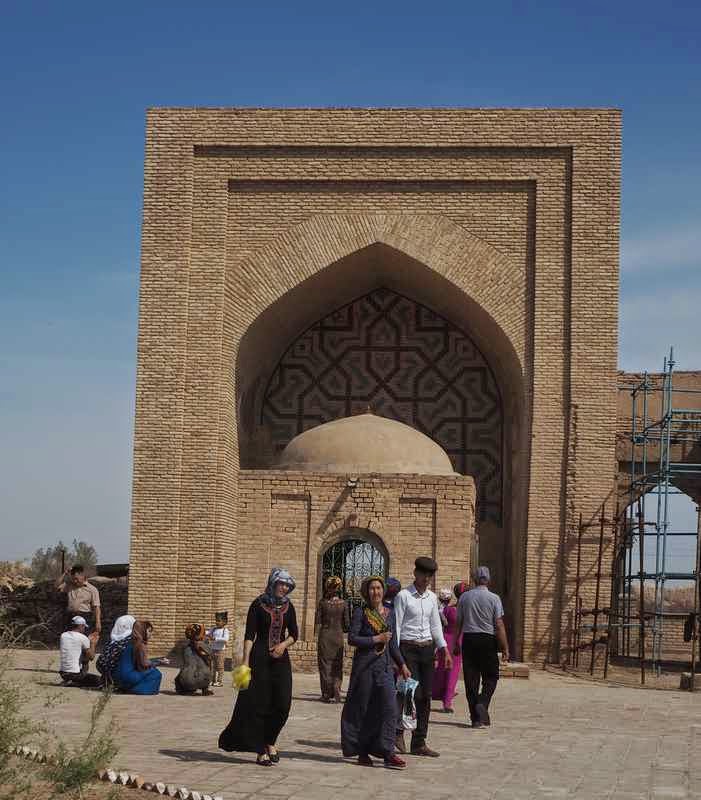
Another holy place the little piles of stones represent wishes.

Pilgrims at Merv.
We had a fast food lunch of samosa near the border and the cook from the proper restaurant next door came to have her photo taken (after she had removed her apron).

Well that is a brief resume of Turkmenistan apart from the saga of the border crossing which will begin the next post.