Tuesday, November 22, 2011

Lakes District, Chile

21st November

Thursday afternoon we left the Atacama and flew to Santiago and then on to Puerto Montt. What a contrast! San Pedro is at about the same latitude as Rockhampton and Puerto Montt about that of Hobart. So here everything is green and lush and the German settlers have created neat and tidy farms with large herds of dairy cattle and enormous German style farmhouses.

We are driving a small manual Peugeot and  the roads are free of traffic, although finding our hotel in Puerto Montt was a little tricky as there are few street names and lots of unsignposted one way streets.

Monument to the 19thC German settlers who took up the offer of free land.
Wood stoves are apparently the way to go!
This seems to be the standard rubbish bin throughout this region.

We are enjoying the freedom of driving ourselves and yesterday - Friday we went to Frutillar a pretty resort town on Lake or more correctly Lago Llanquihue and then today, Saturday, to the Waterfall at Petrohue (Saltos de Petrohue). The lake is surrounded by steep mountains so I found it a bit odd that the falls were draining the lake rather than vice versa. The water is emerald green and very clear. I am not sure what the story was, but in places there were piles of black volcanic ash almost across the road.

Looking across Lago Llanquihue from Frutillar.
The waterfront at Frutillar.

Grand farmhouse near Frutillar.
Waterfall at Petrohue.

Another view of the Petrohue River.

On Sunday we picked up an English couple we had met in San Pedro and set off for Chiloe, a large island. Ruta 5, the motorway which runs the length of the country is a tollway, but you pay just $1 when you leave. It does not vary with distance travelled. When we got to Pargua to catch the ferry to Chiloe, it was pretty low key - no signs, no one directing traffic - just drive on and then set off.

On Chiloe, our first destination was the penguin colony at Punihuil. After negotiating our way through detours in Ancud because of a Fun Run we eventually found the road. There were roadworks the whole way and it was a narrow winding rough gravel road which after 10 or 12 km finished at a beach. We could see activity at the other end of the beach and as the sand was firm drove down. The penguins are nesting on small islands in the bay and the fishermen have a simple but effective system for boarding the boats to see the penguins. Tourists climb onto a trailer which is pushed into the sea and you board without getting wet feet!

We saw Humboldt and Magellanic penguins who nest side by side and are difficult to tell apart.
Black necked swans near Caulin, Chiloe.
One of the very common, pretty red flowered trees.
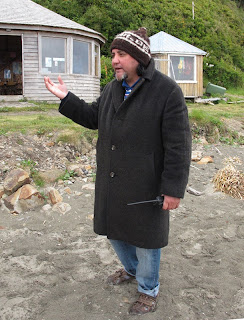
Organiser of the penguin boat trips.
All aboard the trolley to be wheeled into the sea to board the penguin boat.
A Magellanic penguin poses.

Empenadas for lunch was next, before making the return trip to Ancud and the luxury of bitumen for the run down to Dalcahue and Castro to see the UNESCO listed wooden churches and the houses on stilts along the waterfront. It was after 4 p.m. before we headed back to Puerto Varas ready for a good sleep.


The wooden church at Dalcahue.

 Another grand wooden church, this one in Castro.
I like the dashing style of this statue in Castro church.

Palafitos,  or wooden houses on stilts in Castro.

 Monday morning in Puerto Varas was pouring rain and our flight was delayed, but the skies were clear further south and our first views of the Torres del Paine area were spectacular.

Aerial view of Torres del Paine.
Mt Fitzroy in Southern Patagonia.

Atacama Desert Part 2

Thursday 17 Nov

On Wednesday morning we went to the Puritama Hot Springs. All around the country is rocky and barren, although the local cacti grows in cracks in the rocks, but at the bottom of a steep gorge there are 8 natural pools with water at about 33 degrees C and surrounded by pampas grass and quite a lot of birdlife.
Tussocky grass growing around Puritama Hot Springs.
Chilean lizard.
Black headed Sierra Finch - one of many bird species who live around the hot springs.
Wildflowers growing in stony ground near the Hot Springs.
We were really settling into the routine of a morning excursion, followed  by lunch and a siesta and then another excursion. So this afternoon we explored the petroglyphs which date back several thousand years and were important stops along ancient trade routes although now they are in the middle of nowhere. Llamas figure prominently and also pumas.  The Incas themselves (although these petraglyphs predate them) also thought very highly of cats (a point of difference between me and the Incas!)

Pamela explains the Petroglyphs. You can see some in the bottom right hand corner.
Petroglyph of llamas.
Dramatic rock formations of the Rainbow Valley.
Another beautiful sunset

From there we travelled through an oasis (llamas grazing on green feed and the odd poplar tree).  The road was very rough, but we came finally to the so called Rainbow Valley which features rather extraordinary rock formations.

Thursday morning we left San Pedro de Atacama at 5.15 a.m. and drove to the El Tatio Geysers. Our driver Leo did not like eating someone else's dust and so we often left the road and made our own track!. The Geysers are at a height of 4,300 m (14,190 ft) and in the cold early morning (-7 deg C) there are huge columns of steam.

El Tatio Geysers in the early morning
More geysers, this one home to thermophylic algae. An English University is hoping that the algae may provide a treatment for pancreatic cancer.

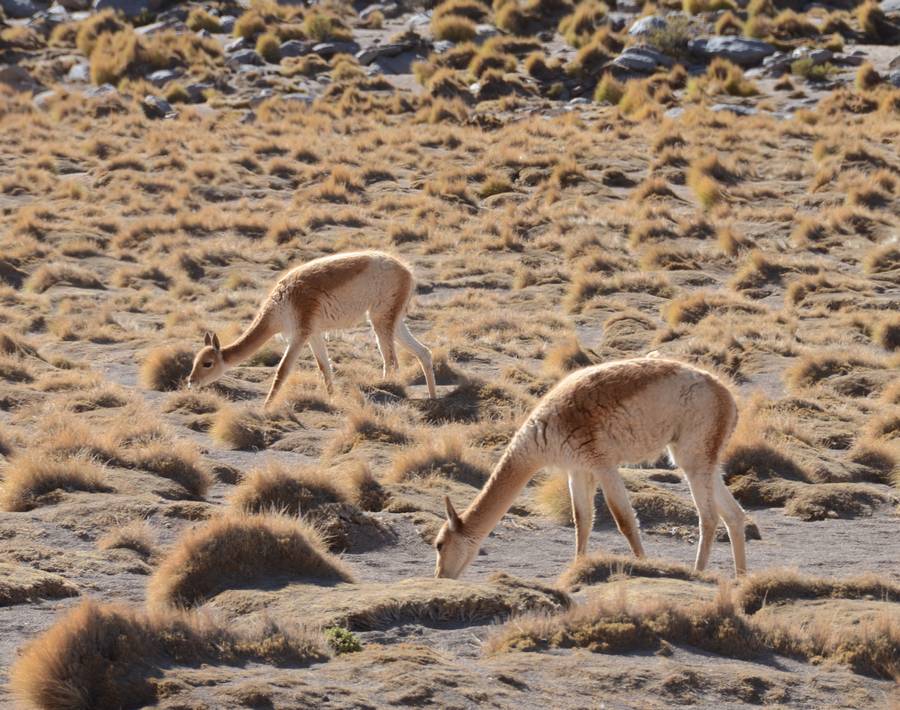
As we returned down the mountain we saw plenty of vicuna (look like small llamas) and also a variety of waterbirds on a permanant lake.

 Vicuna grazing near the El Tatio geyser field
Mama llama and young.
Llamas peeping over a stone wall. The ribbons in their ears are not to provide identification, but are to do with an Indian legend and respecting Mother Earth.
 

Wednesday, November 16, 2011

Pedro de Atacama, Chile

San Pedro de Atacama. Tuesday Nov 15th.

We had a tail wind across the Pacific and landed in Santiago an hour after we left Sydney. Sunday afternoon we walked to the Museum of Pre-Columbian Art. As it was Sunday most shops were closed but plenty of people were out strolling. There are many fine 19thC buildings but far too much graffiti.

The museum has a great collection mostly ceramics but including heaps of very ancient intricately woven textiles.


Three Graces fountain in Santiago.
Some of the mainly Mayan ceramics in the Pre Columbian museum in Santiago.

Monday morning we flew to Calama. Flying along the snow covered peaks of the Andes, which we had not been able to see in Santiago because of the haze/smog. It was then an hour's drive across the desert to San Pedro de Atacama, an oasis town. This hotel is lovely - enormous hollihocks in the gardens and at the bar, everything except Chivas Regal (18 yrs old) and Red Bull is included in the room rate!

Looking out the plane window - between Santiago and Calama.
Hollihocks in the garden of the Tierraatacama hotel.
Our room has a terrace and a view of a volcano (dormant) with an almost perfect cone and some snow, although strangely the snow only fell recently as a result of some very unusual weather conditions.

View from our window at the Tierraatacama.
Last evening we went to the Salt Lakes to see the flamingoes and to watch the sunset. On the way we drove past the site of the new very large radio telescope - an international project with 750 people building it in the middle of nowhere at an altitude of 5000 metres.

We walked around the small village of Toconao and visited the little church. Apparently the Spaniards used to send the faces and hands for the statues of the saints, from Spain and the locals completed the figures. In San Pedro ithere was a statue with articulated arms and legs and the locals could have their photo taken with San Pedro's  arm around them or on his lap, etc. I like the idea of such friendly and homely saints, but apparently someone (an evangelic is suspected) did not and recently burnt the statue.
Small reservoir of fresh water at Toconao which is used to irrigate orchards of apricots, quinces etc.
Cactus wood door in the church in Toconao. This is a very hard dense wood, but  only if you harvest wood from dead cacti.
The Trinity, i.e. Father, Son and Holy Ghost.


Flamingoes take off fromthe Salt lake.
A lone flamingo as the hills behind start to colour as the sun sets.
Sunrise from our room.
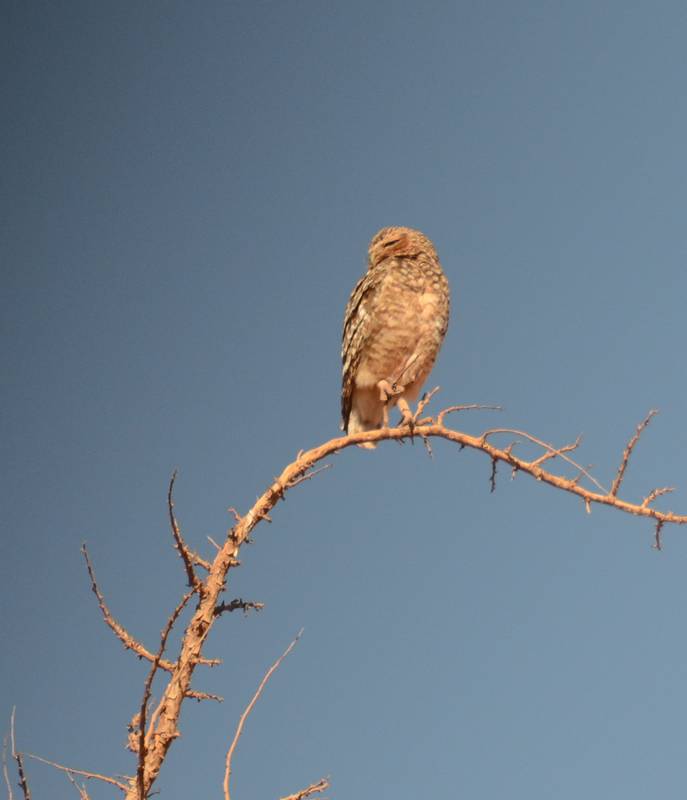
A burrowing owl.
Today was the Valley of the Moon and Death Valley a strangely eroded landscape devoid of life.
The forbidding landscape of the valley of the Moon.
Rock crystals of Salt
This afternoon we thought we would walk into St Pedro. We got lost (one adobe lined lane looks much the same as another!) However the locals were very helpful and our rudimentary Spanish was sufficient. 
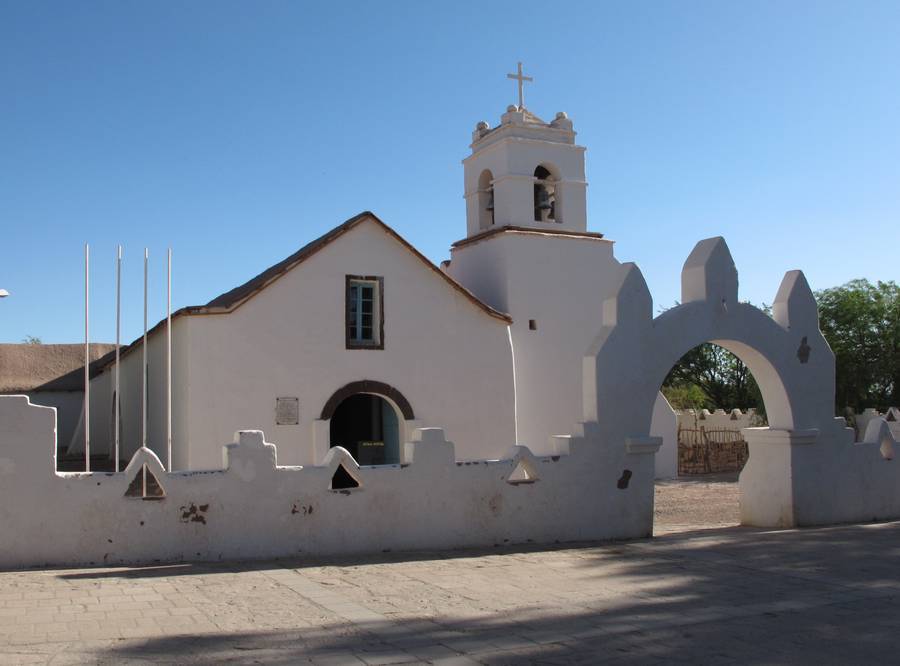
 The church in St Pedro de Atecama
 Statue of the Virgin in St Pedro Church.